Friday, November 24, 2006

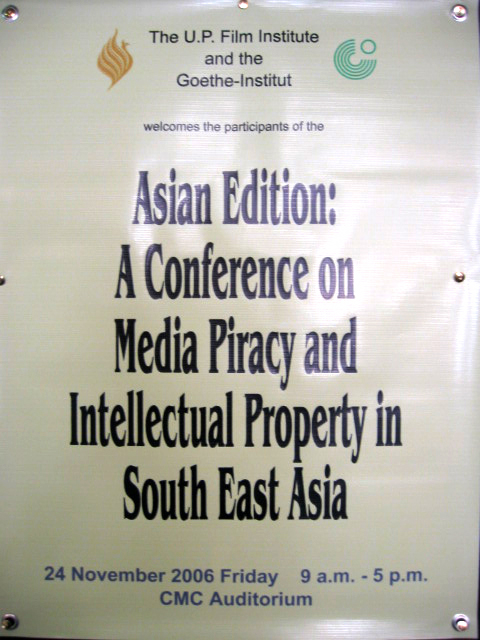
Asian Edition Conference

ASIAN EDITION

A Conference on Media Piracy and Intellectual Property in South East Asia
Sponsored by the Goethe Institute, Manila, and the UP Film Institute


Date: November 24, 2006, 9:00 am – 5:00 pm, UP Film Institute, University of the Philippines, Diliman, Metro Manila, CMC Auditorium

Many Filipinos still remember the "Asian Edition" - a scheme during the Marcos years, when American textbooks were reprinted locally and without paying royalties to the original publishers. Now, “Asian Edition” serves as title for a conference that will look at the phenomenon of media piracy in South East Asia today. Music, movie and software piracy is one of the most prominent media issues of the digital millennium. In the Philippines it has started a whole underground economy and currently seems to change the way movies and other media products are distributed and consumed products here and in other South East Asian countries.

The goal of the workshop is to contribute to an informed discussion of media piracy and issues of Intellectual Property in the age of digital reproduction. Instead of portraying piracy exclusively as a crime against artists and distributors, the proposed workshop will look at piracy as a social, cultural and economic phenomenon. And it will discuss new concepts of addressing ownership of Intellectual Property, such as Creative Commons and Open Source. Dr. Tilman Baumgärtel, Visiting Professor at the University of the Philippines, organizes the conference.


Conference INDEX

http://www.asian-edition.org/index.html

Conference PROCEEDINGS and ARTICLE LINKS

http://www.asian-edition.org/proceedings.html
http://www.asian-edition.org/links.html

Conference Programme and Participants

http://www.asian-edition.org/programm.html
http://www.asian-edition.org/participants.html


Sunday, October 29, 2006

The DVD Rewinder


Too many DVDs, and CDs and not enough time to rewind? Are your DVDs running a bit too slow? The DVD rewinder is the perfect solution! This novelty rewinder comes with the exclusive Centriptal Velocity Spindle providing the world's fastest DVD rewind!

The DVD Rewinder is a great gift for the technical savvy, the couch potato, teens with too much time on their hands, and the gadget buff! Novelty for you or gag gift for a friend.

The DVD Rewinder has a great black and fluorescent green color scheme with high tech styling! The DVD Rewinder will spin discs backwards and plays a rewind sound. You can also record your own rewind sound which provides unending possibilities. For the tech hip, the DVD Rewinder also has an additional MP3 port and plays a separate rewind sound. Rewind all types of disc media DVDs, CDs, and Console Games. But not just novelty, the DVD Rewinder has utility. It has a built in compartment that holds a disc cleaner. This compartment can be used to hold the cleaner, loose couch change, tooth picks, keys or other small items. A truly unique product with a truly unique design!

An actual product for sale, for the bargain-basement price of $16.49. Requires one nine volt battery.

The DVD Rewinder requires (1) 9V battery.

I know someone who could really use this as a gift!You can spend your hard-earned dollars to purchase it here

Tuesday, April 18, 2006

Copyleft: The Freedom to Copy and Share the Work With Others

Copyleft is a play on the word copyright and describes the practice of using copyright law to remove restrictions on distributing copies and modified versions of a work for others and requiring that the same freedoms be preserved in modified versions.

Copyleft is a form of licensing and may be used to modify copyrights for works such as computer software, documents, music, and art. In general, copyright law allows an author to prohibit others from reproducing, adapting, or distributing copies of the author's work. In contrast, an author may, through a copyleft licensing scheme, give every person who receives a copy of a work permission to reproduce, adapt or distribute the work as long as any resulting copies or adaptations are also bound by the same copyleft licensing scheme. A widely used and originating copyleft license is the GNU General Public License. Similar licenses are available through Creative Commons — called Share-alike.

Copyleft may also be characterized as a copyright licensing scheme in which an author surrenders some but not all rights under copyright law. Instead of allowing a work to fall completely into the public domain (where no copyright restrictions are imposed), copyleft allows an author to impose some but not all copyright restrictions on those who want to engage in activities that would otherwise be considered copyright infringement. Under copyleft, copyright infringement may be avoided if the would-be infringer perpetuates the same copyleft scheme. For this reason copyleft licenses are also known as viral or reciprocal licenses.

More on COPYLEFT: http://en.wikipedia.org/wiki/Copyleft

There's The Rub / 10 things to love about being in the Philippines

There's The Rub
10 things to love about being in the Philippines
By Conrado de Quiros
Inquirer

First posted 00:30am (Mla time) April 18, 2006


THE IDEA for this column cropped up in my head late last week. I had pretty much forgotten how great Metro Manila felt without the crush of cars and jeepneys, beggars and businessmen, saints and sinners spilling out into its streets every day, until I drove around last Holy Thursday and Good Friday. Most Metro Manilans had left for their hometowns, if not for Boracay and Baguio City, and the taste of Metro Manila, near-emptied of its mechanical and human contents, was not unlike wine. Driving through deserted roads gave me a glimpse into how an Arab must feel driving through desert roads. It brought back memories of the time when I used to ride the JD and DM buses from Katipunan Road in Quezon City to Quiapo in Manila (that took only 15 minutes), which now seems like ancient history even to me.

The air was redolent as much of summer ease as of Lenten penitence, which made me think of some of the things to love about living in this country. My list breezed past 10, but columns are not hospitable to more than 10 of the things to love about being in the Philippines -- which does not include writing columns. So 10 it is:

One, Baguio and Boracay. Baguio is the old summer capital, Boracay the new one. Mountain or sea, take your pick. Though Baguio has been greatly ravaged by modernity -- enough to make you sing (appropriately, Baguio being home to “folk” music) Joni Mitchell’s line, “They paved paradise to put up a parking lot” -- it still retains its charm, at least for me, aided in no small way by a rush of memories. I haven’t been there in some time and find myself now and then longing for it.

Boracay, well, it makes a good claim to being the next best thing to paradise on Earth, though some beaches in Bohol province, notably on Panglao Island, can give it a run for its money. Personally, I find the addition of nightlife a boon and not a bane: I’m not one of those who like to rough it up in the company only of the moon and stars. Beer and good company help to make the sand sparkle in the night. In any case, I don’t much like dipping into the water, I just like walking on beaches. But that’s another story.

If you like the beach, you’ll probably like the people who inhabit it, too, especially the ones in Boracay. But I’ll stop there lest I get into trouble.

Two, fruits. My all-time favorite is mangoes, which have no peer in the world. Of course, you’ll find people from other Asian and Latin American countries boasting about their own mangoes, but I’ve tasted a variety of mangoes from all over the world, and I can say with reasonable certainty that none of them compares to ours. Our mangoes are the absolute best.

As well indeed as many of our other fruits, which teem all over the place at this time of year. I’ve always associated summer with fruits, the trees, which grew in abundance where I lived when I was a kid -- and this was supposed to be a city! -- groaning with the weight of them. The idea of buying fruits was inconceivable then. Fruits were not something you bought, they were something you picked. But that, too, now seems like ancient history.

Three, hometowns. The desolation of Metro Manila during Holy Week drove home the point that most residents of Metro Manila come from somewhere else in the country. “Taga saan ka?” [Where are you from?] is a normal question you ask of a Metro Manilan, which suggests that those whose antecedents for several generations date back to any part of the metropolis are the minority, probably a small minority. My own hometown is Naga City, though I was born in Manila. It is where I spent my boyhood and adolescence and learned my first language, which is Bicol. It is where I go to charge my psychic batteries. I barely know anybody there anymore from childhood, but the place itself holds a raging volcano of memories for me, which sends electrical surges through my soul. Hometowns give you a sense of bearing in a world -- especially so this country -- seemingly drifting in space, bound for nowhere.

Four, the sun. That, of course, is also something to hate about living in this country when the heat becomes especially ferocious at this time of year. But you live in a cold place, and truly you’ll learn to love the sun. I’ve been in Europe in the bitter cold a couple of times and was instantly cured of Christmas-y notions of winter wonderlands. Once when sunlight seeped through the gray skies in the Oxford area where I was visiting some years ago, I swear I thought I would see the natives fall on their knees and pray. The exultation was universal, the sighs of gratefulness spontaneous and audible.

I don’t hate it that we only have two seasons in this country, the rainy and the dry, which in these days of El Niño and La Niña weather disruptions are not so easy to demarcate anymore. I like it that we do, if only because of the teeming street children Metro Manila in particular is home to. Can you imagine them lying in the pavement in the bitter cold? I have these images of Russians being picked up in the morning like litter after freezing to death from lying in the snow roaring drunk. Of course, the fact that we do have children sleeping on the pavement while Mike Arroyo barely inhabits princely suites in Las Vegas to watch boxing champion Manny Paquiao fight is something to hate about living in this country. But I leave that for the nonce.

Five, summer. It revives memories of Connie Francis belting out “V-a-c-a-t-i-o-n!” The kids are home from school, though “home,” for those who have teenage sons in particular, is hugely debatable. Over the last several weeks, I’ve barely seen the shadow of my 17-year-old son. Well, I guess let them be. It’s the time of their life, the best years of their life, the happiest years of their life. It won’t come again.

SIX, DVD and software. It used to be you went to the United States to buy DVDs, software and books. Well, today you still go to the United States (and elsewhere) to buy books. I still remember the row upon row of bargain books in The Strand in New York, a cavernous bookshop where you need a ladder to get to the tomes on the top shelves. Many of them were still new and hardbound. The DVDs, well, the last time I got them in the United States was in 2001, shortly before 9/11, and I counted myself lucky to have bought them on sale.

Today, you do not go to the United States to buy DVDs; your folks in the United States come here to buy DVDs. Or importune you to send them some, such as your messenger is intrepid enough to risk problems at Immigration. Indeed, today your problem is not how to lay your hands on DVDs, or on good titles, your problem is how to organize the tons of them, including absolute classics, that are piling up in your not very big house. I have solved that problem by buying them without the case and storing them in canisters. I still have to solve the problem of how to find the time to watch them.

Those who feel like berating me for listing the DVDs from the Quiapo district in Manila among the things that make this country livable might first wish to examine whether the Windows they're using to boot their PCs and the software they're using to write their furious letters with are original or licensed.

Seven, Quiapo. Before my mother suffered a stroke some years ago, which much debilitated her mind if not her body, she used to go to Quiapo to do her marketing. She was born and raised in Manila. The fact that many markets, wet or super, were near did little to dissuade her from making the long trip by jeepney. She was already past her 80s then, but she was strong and strong-willed. Nothing beats Quiapo for the real deal, she said.

She was right. It was so then, it is so now. It's the one place where you get the best bang for the buck, in more ways than one.

It's a place, too, where you find tolerance amid difference, pattern amid incongruity, order amid chaos. It's the place where the Quiapo church stands just across the street from the mosque. It's the place where the sounds of prayer mingle with the cries of barkers, where bankers thrive with sellers of snake oil, where the benefits promised by public officials vie with the efficacious results promised by the peddlers of "pampalaglag" [abortifacients]. It's grimy, noisy and pushy. It's honest, colorful and sublime.

Eight, the countryside. That is to say, any place outside Metro Manila, not necessarily your hometown. The food is cheaper and the smiles are broader. In past years, I used to travel a lot across the country to talk in graduations and forums but I have kept to Manila of late because of pressing concerns. I like visiting the Visayas for many reasons, not the least of which is that it is accessible by air and sea. But more than that, the Spaniards were right: It's the land of the "pintados" [tattooed people], of a people given to wine and song. I won't mention what goes along with wine and song lest I get into trouble as well.

Of course, it's not always easy to keep an Amorsolo image of the countryside amid the want and strife to be found there. But you'd be a fool to imagine that's all you'll find in the countryside. Especially in summer, when the sun dangles from a cloudless sky and shimmers across undulating field and heaving sea. It's always a little brighter in the countryside in summer, which pulls you to it like, well, an Amorsolo painting.

Nine, "kakanin," "halo-halo. When I was a kid, you found the "kakanin" (pudding, rice cakes, etc.) plentifully in the market. But if you were too lazy to take the short walk there, there were the itinerant vendors who hawked the stuff in the streets. I recall that at one point one of our teachers in high school, an American Jesuit, who had been insisting that we speak slowly, audibly and clearly in class, pointed triumphantly to one of those itinerant vendors and cried, "That is how you should recite!" You could hear the voice of the kid from a distance shouting "Baduya" (banana drenched in batter) in the tones of an angel. Kakanin's gain, amateur hour's loss.

Two things I've always associated with summer: "tuli" [circumcision] and "halo-halo" [iced mix of fruits and other ingredients]. The first came from announcements in newspapers and signs in streets that said almost cryptically, "Summertime: Tuli!" To this day, I find myself saying that phrase every time Gershwin's famous ode to summertime is sung. The second is halo-halo, a concoction that makes you see and feel the haze of summer. Not least because it truly makes you full and sleepy. I know most of the ingredients there -- beans of all shapes and sizes -- are gout-inducing, but I figure that these days in particular there are more things to give you pain in this country than gout.

Ten, the people. I still recall something a friend of mine, an American banker, told me before he left for another post. He had pretty much gone around the world, he said, but he found few people as genuinely warm and solicitous as Filipinos. Of course, in excessive form, he said, Filipinos also tended to be familiar and intrusive, as when new acquaintances went on to pry into his personal life. But even that he found to be largely harmless, if not well-meaning. In the United States, he said, waiters and sales clerks greeted you, "Have a good day," but there was little joy or conviction in their eyes. Here, people said "Ingat" ["Take care"], and meant it.

I did think of writing as well "10 things to hate about being in the Philippines." But either that goes well past 10 or it can be reduced to just one, take your pick.

But that's quite another story. It's Easter, I'll leave the tragedies for tomorrow.

Editor's Note: Published on page A12 of the April 18, 2006 issue of the Philippine Daily Inquirer
Wednesday, January 11, 2006

There's The Rub / Encounters

There's The Rub
Encounters
By Conrado de Quiros
Inquirer

First posted 11:32pm (Mla time) Jan 10, 2006


A FRIEND of mine asked me if I had any thoughts about initiatives that could help bridge the divide between Muslims and Christians in this country. He and some colleagues were looking for instances of dialogue, or cultural encounters, that promoted peace, or curbed hostilities, between those warring factions.

I said half in jest that my friend would do better looking for those instances not in the south but right here in the city. As far as I knew, I said, the perfect model for Christian-Muslim harmony was to be found in Quiapo. Nothing spoke of the heights of mutual tolerance than the Quiapo Church, bastion of Catholicism, on one side of the street coexisting with the Muslim mosque, citadel of Islam, on the other side of it.

Thinking about it later, however, I realized it wasn't a joke at all. A perfectly serious case could be made for it. The "taming of the Moro [native Muslim] quarter" in Quiapo should make for an interesting study, academic or otherwise, offering as it does a wealth of insights into how to turn swords into plowshares.

Not too long ago, the place was a virtual no-man's land. During Alfredo Lim's time as mayor of Manila, in particular, the "Muslim center," as it was often referred to, which is that side of Quiapo opposite the Quiapo Church, past the underpass, all the way to Arlegui, Globo de Oro, and the other small clogged streets that run through there like the arteries of someone badly needing a heart bypass, was whispered with the same awe and dread as "Tondo" in the 1960s. It was not uncommon to find "salvage" victims there. Nor was it uncommon to find close encounters of the bloody kind between cops and robbers there, the robbers disappearing into the folds of the place as into a foggy redoubt and the cops refusing to follow. Many a cop that did so failed to come out alive.

That at least was the image that gripped the public mind, aided in no small way by the tabloids that screamed the mayhem in bold headlines. Until a few years ago, vestiges of that unsavory reputation still clung to that place. When I told people that the cheapest place to buy DVDs was in Quiapo, specifically the Muslim area, some of them were aghast and marveled at my intrepidness in venturing that far afield. I assured them there was nothing fearful about the place, it was nowhere near the wild frontier they supposed it to be. The wariness has disappeared almost completely today. The place is still a sprawl, dirty and grimy, and muddy on rainy days, but it is also home particularly on weekends to Mitsubishi Pajero and Honda CRV sports utility vehicles, parked on its periphery, in the area under the Quiapo Bridge. Or what used to be called "Isle de Tulle," the Frenchified "ilalim ng tulay," or under the bridge.

What had wrought this amazing transformation? The DVDs, of course.

Or more accurately the "pirated DVDs," which can be bought for a song in those parts, or however P50 counts these days. The periodic raids of Edu Manzano's henchmen notwithstanding, which look more and more like an elaborate ritual taken for PR purposes, the DVD market grows by leaps and bounds. The fringes are caught up in it too and keep expanding. The downside I leave the believers in intellectual property rights to argue. The upside is that you find no quarrels between the inebriated crowd that heaves the Black Nazarene through the streets on its feast day shouting pious litanies and the sober one loudly chanting praises to Allah particularly during the lean and hungry days of Ramadan. If that isn't tolerance, I don't know what is.

Two things I gather from this, which could have some bearing on the work of peace advocates. One is that the presumed animosity between Christians and Muslims in this country is more imagined than real. I don't know how it is in Muslim Mindanao, I suspect it is just as exaggerated. The animosity hasn't seeped into the level of the man in the street. I do know that in the Visayas, there are still numerous reminders of the Moro piratical raids. Tagbilaran, the capital of Bohol, as I learned some years ago, means "tago B'laan," or to hide from the pirates. I do know that the Feast of the Cross in some parts of Leyte is related to the many miracles the Cross of Christ apparently worked to protect Visayan communities from the Moro pirates in Spanish times.

But I don't know that the animosity is active today among ordinary folk. The distrust seems to have less to do with the idea of a Moro stabbing you in the back than with him stabbing you in the pocket. Courtesy of all those jokes about the Moro trader, but which are no more and no less than the jokes about the sly Chinese and shrewd Bombay.

The second and more important thing you can glean from the experience is that you turn people into stakeholders, or give them a stake in peace, you get peace. People who have a source of livelihood will not imperil their source of livelihood. Today, the "barangay" [neighborhood district] council in the Muslim quarter zealously keeps the peace there, fearful that any mugging or bloodletting could ward off the droves of visitors that regularly descend on it. Of course some people will argue that pirated DVDs, which for reasons I have yet to fathom have become a Moro franchise-they're the ones selling the thing even in Baguio City, or so someone tells me-are not unlike Colombian cocaine. And some will say the pirated DVDs suggest that Moros have not gotten over their time-honored skullduggery. I disagree completely, though I'll leave my arguments there for another day. Suffice it for me to say that the only thing that suggests skull and crossbones from where I stand are the periodical raids of Edu's men which take on the aspect of Francis Drake's one-eyed and toothless men looting the loot-laden Spanish galleons.

By the way, have you seen the early works of Ingmar Bergman...?

Editor's Note: Published on Page A12 of the January 11, 2006 issue of the Philippine Daily Inquirer

Thursday, September 9, 2004

There's The Rub / Still, Isle of Tortuga

There's The Rub
Still, Isle of Tortuga
by Conrado de Quiros
Inquirer News Service

First posted 10:12pm (Mla time) Sept 08, 2004


I DID see one unpleasant thing in the stalls that sold pirated DVDs in Quiapo last weekend. That was the presence among them of local titles. In the past, I used to see only movies starring Sharon Cuneta, Judy Ann Santos (I think) and various action ones. This time I saw Gil Portes' "A Beautiful Life" and Joel Lamangan's "Mano Po" and "Pamilya." "Imelda" was there as well, except that, as the vendors tipped, "it wasn't DVD yet, just a clear copy." I don't know what other Filipino movies are sold there. They weren't in all the stalls, only in some of them.

I draw the line at buying local stuff. That has been my policy all this time, and that has been the policy I've recommended to government all this time. That was the advice I gave Tito Sotto a couple of years ago when he asked to meet with me on the subject. He was then head of the Senate committee on intellectual property rights, which covered piracy. I said the only rational policy was to stop the pirating of local movies and CDs. You cannot stop piracy completely, that is a hopeless cause. The technology is there. You can no more bind the explosion in productive capabilities to old property rights than you can cage King Kong in the zoo. But you can at least curb, if not stop, the pirating of local movies and CDs.

You can do that by running only after those who sell pirated local movies and CDs. I'm sure you can appeal to the public's patriotic sentiments to not buy the pirated local stuff. I'm just as sure you won't find resistance, or cynical reaction, to cops swooping down on the pirates' lair and carting off bundles of pirated local movies and CDs. The public might even applaud them.

The justification for such a policy should be national interest and not moral scruple. The reason is simple: You make moral scruple the basis for running after people selling, or buying, pirated movies and music CDs, you have to run as well after those selling, or buying, pirated software. It's the same principle.

But you do the latter and the country will grind to a halt. The educational system will grind to a halt, the banks and courts will grind to a halt, the entire government will grind to a halt. That is because easily 99 percent of the computers in this country use pirated operating systems and pirated programs.

That includes the computers of the entertainers who are fulminating against piracy. That includes the computers of Bong Revilla, ex-Videogram Regulatory Board head and current senator, and Edu Manzano, ex-TV host and current board head. The day they are able to show their press statements are written on licensed Microsoft Word from computers booted with licensed Windows XP is the day I join their crusade without reservation. Otherwise, they're just being hypocrites.

Sotto's office did call me a couple of years ago to say a bill incorporating my suggestions (making the pirating of local movies and CDs, on ground of national interest, illegal and punishable by law) was being prepared. I don't know if it was ever finished, if it got to the floor of the Senate, or if it met with furious opposition from various lobbies. But clearly it hasn't been enacted, freeing Manzano to mount his movie antics in real life.

It is the only reasonable policy toward "piracy"--which I put in quotation marks because the GATT-WTO concept of intellectual property rights is itself piratical; at least the pirates of Tortuga stole from the rich, this one steals from the poor. More so now than ever. There are two new and compelling reasons why this is so.

The first is that the selling of pirated DVDs gives livelihood to the ragged urban denizens who might otherwise take to crime--this is not so, to anticipate the snide remarks of Bill Gates' representatives on earth--to bring food to the table. That is no mean feat particularly in these days of great want, and coming days of even greater want. The last thing we need is to add more unemployment to the country, particularly among the ranks of the Muslim poor in Metro Manila, who for some reason seem to have monopolized the retail trade in pirated DVDs. It's not a matter of preference, it's a matter of survival.

In fact, the last thing we need is government using our taxes to keep an office that exists to protect foreign interests. I don't mind that the portion of my pay I am forced to part with goes to supporting local artists, I do mind that it goes to protecting Paramount and 20th Century Fox.

The second is that, well, do you want to keep this country ignorant? Education is its own justification. The United States itself did not mind pirating British books to enlighten its nationals before 1776. If it hadn't done so, it might still be a British colony. I personally do not mind being reproduced all over the place (which I am), if that will improve people's minds. I'm shareware entirely, the spirit that happily still rules the Internet.

The explosion in DVD titles, which now include Hollywood classics as well as movies from other countries, is particularly welcome. My own take there is that this should help the more serious makers of local movies by enlarging the scope of their market. Currently, they have to cater to a market whose taste has been molded by Hollywood "blockbusters" and B action movies. The availability of the classic movies should raise the Filipino taste several notches higher, which should boost the chances of the Lino Brockas and Ishmael Bernals of this country peddling their wares.

Bong Revilla was just lucky, there is no political future in raiding the lost ark. Edu Manzano should really stop to think before he makes his next move. Or he may end up at the receiving end of his favorite barb in "Weakest Link." Which is: "Goodbye."

Editor's Note: Published on page A12 of the September 9, 2004 issue of the Philippine Daily Inquirer

http://web.archive.org/web/20060104181646/http://news.inq7.net/opinion/index.php?index=2&story_id=9729&col=77

Saturday, October 4, 2003

Twisted / Copy This

> Copy This
Jessica Zafra


Does anyone else find it funny that people who make much more money than we do are appealing to us not to deprive them of their income? You have the nerve to charge me P450 for a CD that is being sold on the street for P60, and you expect my sympathy?

The campaign against pirated software, CDs, VCDs, audio- and videocassettes, would have us believe that piracy is our problem. Really? How is shelling out P100 for a disc that contains P50,000 worth of software a problem for me? It would seem that the pirates are doing me, and my shrinking wallet, a big favor. Why should it bother me that a movie which has not yet opened in Metro Manila theatres is being peddled on VCD on Ayala Avenue for P90? I have no fight with the pirates. They are selling me information I might otherwise not have access to because of prohibitive costs. Yes they are thieves and thieves should be punished, but they are not stealing from me. Oh sure, you can lecture me about how in the long run I will pay for buying bootleg, but by then I will have used the information for my benefit.

So let me make a correction. Piracy is the problem of the manufacturers —the software houses, record companies, and motion picture companies—whom I shall refer to from hereon as the corporations. By telling us not to buy pirated materials "for the good of everyone," corporations make it appear that corporate interests and the public interest are the same thing. This is laughably untrue. Corporations make noises about working in the public interest—these noises are called public relations, PR—but their duty is to their owners.

The anti-piracy ads, with their appeals to my virtue, pass the responsibility of combating piracy to me. HELLO. They invoke the law and call on my conscience to protect their profit margin, but when I shell out P450 for a CD that turns out to be crap, I can't invoke the law, and corporations have no conscience. We may all be equal under the law, but they have the best lawyers. I guess their complaints are valid because they stand to lose more money, while I'm just a sucker who bought the promotional hype.

The anti-piracy campaign says that when we buy unauthorized copies, a.k.a. bootleg, we are stealing from the creators of the music, movies, or computer programs. This would be the case if the proceeds of the sales went to the artists themselves. We know that the artists get a small royalty; most of the money goes to the corporations. They profit from the work of the artists. In exchange for a small royalty, they can suck their artists dry. Their excuse is that they spent vast sums of money on the marketing of the artists' work. In short, the reason "originals" cost so much is because the huge marketing expenses are passed on to us. Why should we finance the ridiculous costs of hype?

When you buy bootleg, you deny the artist a couple of bucks, but you stick it to the corporation, which is so rich it won’t even say ouch. I find it hard to summon up any sympathy for a multi-billion dollar entity that does business in over 100 countries. Aww, the poor corporations, their executives won't be buying personal Lear jets this quarter. Buying bootleg has a Robin Hood appeal: Rob the rich to give the poor, meaning you. It's the opposite of jueteng, in which one robs the poor in order to give to the rich.

The corporations are laying a massive guilt trip on the consumers when they should be working to make their products less easy to steal. With the technology we have, it is extremely easy to make high-quality copies of anything. In the past we worried that bootleg goods could damage our electronic equipment; today's fake CDs are almost exactly like the originals. While the corporations are piracy-proofing their wares, maybe they should cut us a break and drop their prices. The pirates have shown that it is possible to make CDs cheaper. Take the hint, and spare us the sob stories about high marketing costs and your dwindling profits.

I don't buy pirated software—not just because pirates don't usually do Mac programs, but because I love my Mac. But I can not tell PC users not to buy bootleg software when it costs one-fiftieth the price of the original. Caveat emptor, naturally, and the fake software may cause their PCs to crash, but PCs do that anyway. Hey, doesn't the idea of bilking Bill Gates of .000000000000000000(add more zeroes)1 of his income appeal to you? Look at him, the guy's rolling in money, but he won't spend for a proper haircut. Besides, if you really want to quibble over it, didn't Bill Gates and Steve Jobs borrow information from the Xerox Palo Alto Research Center?

Cut the crap, and stop appealing to my good nature. It is not my job to protect your interests. The pirates are sleazy, but they have inadvertently raised the possibility of a future in which the artist reaches her audience directly, without a corporate middleman. Think of a future in which you profit from your own ideas. Not bloody likely, right, but it's a good thought.