United States Trade Representative (USTR) cites Quiapo's notoriety for selling counterfeit and pirated merchandise in page 8 of its 2008 Special 301 Report. The report doesn't mention anything specific on illegal optical media trade in the Philippines in relation to the Quiapo DVD market.
Read the whole report here:
http://www.ustr.gov/assets/Document_Library/Reports_Publications/2008/2008_Special_301_Report/asset_upload_file553_14869.pdf
Page 7, Notorius Markets...
Notorious Markets
Global piracy and counterfeiting continue to thrive, due in part to large marketplaces that deal in infringing goods. This year’s Special 301 Report notes the following virtual and physical markets as examples of marketplaces that have been the subject of enforcement action, or may merit further investigation for possible IPR infringements, or both. The list represents a selective summary of information reviewed during the Special 301 process; it is not a finding of violations of law. The United States encourages the responsible authorities to step up efforts to combat piracy and counterfeiting in these and similar markets.
Virtual Markets
Allofmp3 (Russia). Industry reports that allofmp3 was formerly the world’s largest serverbased pirate music website. Although the site’s commercial operations appear to have been disabled in 2007 and a criminal prosecution is pending, other Russian-based websites are reportedly continuing operations with similar infringing content.
Baidu (China). Industry has identified Baidu as the largest China-based “MP3 search engine” offering deep links to copyright-protected music files for unauthorized downloads or streaming. Baidu is the target of ongoing infringement actions.
Business-to-business (B2B) and business-to-consumer (B2C) websites (China). A large number of these Chinese websites, such as Alibaba and Taobao, have been cited by industry as offering infringing products to consumers and businesses. The Internet traders who use these online markets to offer counterfeit goods are difficult to investigate, and contribute to the growth of global counterfeiting.
PirateBay (Sweden). Industry reports that PirateBay is one of the world’s largest BitTorrent tracker sites and a major global conduit for the unauthorized exchange of copyright-protected film and music files. PirateBay was raided by Swedish police in 2006, and the government initiated the prosecution of four Swedes associated with the site in January 2008, but the site has continued to operate, reportedly relying on servers located outside of Sweden.
Physical Markets
Silk Street Market (Beijing, China). Industry has cited Beijing’s Silk Street Market as “perhaps the single biggest symbol of China’s IP enforcement problems.” In 2005, authorities began to pressure the landlords of Silk Street Market and other major retail and wholesale markets in Beijing to improve compliance with IPR laws. In 2006, right holders prevailed in several court actions related to the market, and executed a Memorandum of Understanding with the landlords in June 2006. A January 2007 industry survey of the market reportedly showed that counterfeiting has worsened, with apparent violations in 65 percent of all outlets. More recent industry reports indicate that counterfeiting at Silk Street Market remains at critical levels.
China Small Commodities Market (Yiwu, China). The China Small Commodities Market in Yiwu reportedly sells approximately 410,000 different items, mostly small consumer goods. Industry has cited the market as a center for wholesaling of infringing goods. Officials in Yiwu have met repeatedly with U.S. Government officials and stressed their work to improve IPR enforcement. Industry confirms that enforcement in Yiwu has improved. Continued improvement is needed, particularly in the area of criminal enforcement.
Gorbushka, Rubin Trade Center, and Tsaritsino Markets (Moscow, Russia). Industry representatives report that piracy problems persist in these markets, though the situation has improved at the Gorbushka and Rubin Trade Center.
Tri-Border Region (Paraguay, Argentina, and Brazil). The Tri-Border Region of Paraguay, Argentina, and Brazil has a longstanding reputation as a hotbed of piracy and counterfeiting of many products. The U.S. Government is funding a training project through which U.S. Department of Justice and U.S. Department of Homeland Security officials will train prosecutors, police, and customs officials from the Tri-Border Region to combat intellectual property crime. Although Ciudad del Este remains the hub for pirate activities in Paraguay, industry reports that trade there has declined and that commercial concentrations are shifting to other cities. Through a revised Memorandum of Understanding between the United States and Paraguay on IPR enforcement, the United States will be encouraging Paraguay to increase enforcement action with respect to a number of specifically-identified markets in that country.
Tepito, Plaza Meave, Eje Central, Lomas Verdes, and Pericoapa Bazaar (Mexico City); Simitrio-La Cuchilla (Puebla, Mexico); San Juan de Dios (Guadalajara, Mexico); and Pulgas Mitras and La Ranita (Monterrey). An estimated 50,000 vendors sell IPR products in Mexico’s ubiquitous, unregulated street markets. Past police raids on such markets have sometimes been met with violent resistance, requiring large contingents of security personnel.
Czech Border Markets (Czech Republic). Hundreds of open air market stalls are notorious for selling pirated and counterfeit products near the Czech border, including at the notorious Asia Dragon Bazaar in Cheb City. Many of these markets are highly organized, and even advertise on the Internet.
La Salada (Buenos Aires, Argentina). This is the largest of more than 40 large, wellestablished markets in Buenos Aires that have been cited as being heavily involved in the sale of 9 counterfeit goods. An estimated 6,000 vendors sell to 20,000 customers daily. The market is reputed to be a haven for organized criminal gangs that operate from within it, resulting in little to no IPR enforcement.
Neighborhood of Quiapo (Manila, Philippines). Street stalls in this neighborhood are notorious for selling counterfeit and pirated merchandise. Other notorious markets in Manila include Binondo, Greenhills, Makati Cinema Square, and Metrowalk.
Harco Glodok (Jakarta, Indonesia). This is reported to be one of the largest markets for counterfeit and pirated goods in Indonesia, particularly well-known for pirated optical discs. Enforcement officials are reportedly reluctant to conduct regular enforcement actions because of the presence of organized criminal gangs.
Panthip Plaza, Mah Boon Krong (MBK) Center, Klong Thom, Patpong, and Sukhumvit Road (Bangkok, Thailand). These locations are notorious for openly selling pirated and counterfeit goods. They are all designated as “red zones” by Thai authorities, which indicates that they are places where infringing products are most readily available.
Page 43, Watch List 2008...
PHILIPPINES
The Philippines will remain on the Watch List in 2008. The United States is concerned about U.S. industry reports of an apparent increase in piracy in the Philippines, particularly in the areas of book piracy, illegal downloads using mobile devices, piracy on the Internet, and the illegal camcording of films in theaters. The United States urges the Philippines to take steps to reverse these trends and strengthen its enforcement regime against piracy and counterfeiting. Specifically, the Philippines should pursue final determinations in outstanding IPR cases, including those related to cable piracy, with imposition and implementation of deterrent-level penalties. The Philippines also should strengthen the Optical Media Board and provide it with adequate resources to expand and improve the effectiveness of its activities; strengthen the Customs IP unit; ensure that its patent regime complies with the World Trade Organization Agreement on Trade-Related Aspects of Intellectual Property Rights; enforce copyright protection of printed material; and seek to obtain amendments to the Copyright Act to implement the WIPO Internet treaties. The United States will continue to work with the Philippine Government under the bilateral Trade and Investment Framework Agreement to strengthen the Philippines IPR regime.
Friday, May 2, 2008

Tuesday, April 15, 2008
Republic Act 9239: Optical Media Act of 2003
Full Text of RA 9239 at http://www.chanrobles.com/republicactno9239.html
IV. PENAL PROVISIONS
Section 19. Offenses and Penalties. -
(a) Imprisonment of at least three (3) years but not more than six (6) years, and a fine of not less than Five Hundred thousand pesos (Php 500,000.00) but not exceeding One Million five hundred thousand pesos (Php 1,500,000.00), at the discretion of the Court, shall be imposed on any person, natural or juridical, who shall:
(1) Engage in the importation, exportation, acquisition, sale or distribution of, or possess or operate manufacturing equipment, parts and accessories without the necessary licenses from the OMB;
(2) Engage in the mastering, manufacture, replication, importation or exportation of optical media without the necessary license from the OMB;
(3) By himself, or through another, cause the mastering, manufacture or replication of any intellectual property in optical media intended for commercial profit or pecuniary gain without authority or consent of the owner thereof;
(4) Engage in the Mastering, manufacture, or replication of optical media without affixing or installing in the resulting products the SID Code, and/or such other codes prescribed, assigned and authorized by the OMB. The absence of the codes prescribed, assigned and authorized by the OMB in any optical media shall be prima facie evidence that said optical media are in violation of this Act;
(5) Engage in the mastering, manufacture, or replication of optical media using, affixing or installing in the resulting products false SID or other codes. The presence of false or unauthorized codes shall be prima facie evidence that said optical media are in violation of this act;
(6) Engage in the mastering, manufacture, or replication of optical media using, affixing or installing in the resulting products false SID or other codes that have been assigned by the OMB to another person, or, having been assigned and authorized said codes by the OMB, allow or authorize another person, establishment or entity to use, affix or install such codes in the latter's products;
(b) Imprisonment of at least one year but not more than three years and a fine not less than one hundred thousand pesos, but not exceeding five hundred thousand pesos, at the discretion of the court, for the following offenses:
(1) Engaging in the importation, exportation, sale or distribution of, or possess or acquire in commercial quantities manufacturing materials used or intended for use in the mastering, manufacture or replication of optical media without the necessary licenses from the OMB;
(2) Knowingly performing or rendering the service of mastering, manufacture or replication of optical media, after having been licensed by the OMB, to any person, in respect of any intellectual property, who does not have the consent by the owner of the intellectual property or his representatives or assigns;
For this purpose, any person, establishment or entity that is licensed by the OMB to engage in the above mentioned activities shall be considered to have acted in good faith in respect of any transaction entered into by him in respect to the preceding paragraph, if he notifies the OMB of such transaction within five working days from receipt of the order, furnishing to the OMB all material information thereof;
(3) Refusing to submit to inspection by the OMB, or surrender for preventive custody any optical media, equipment, manufacturing materials, including parts, accessories and paraphernalia found during inspection operations to be in violation of the provisions of this Act;
For purposes of this subsection, violators who will employ armed resistance against agents of the OMB shall be penalized under other applicable laws in addition to those provide in this Act:
(a) Imprisonment of at least 30 days but not more than 90 days or a fine of not less than 25,000.00 pesos but not exceeding fifty thousand pesos at the discretion of the court:
(1) Knowingly possess items of the same content or title, produced in violation of this Act, and used for the purpose with the intent to profit;
(2) Engaging in the sale, rental, distribution, importation, exportation of, or any other commercial activity involving optical media that are in violation of this Act.
(b) For subsequent offenses in Section 19(a), uniform imprisonment of six (6) years but not more than nine (9) years and a fine of not less than One Million five hundred thousand pesos (Php 1,500,000.00) but not exceeding Three million pesos (Php 3,000,000.00) at the discretion of the Court, shall be imposed.
(c) For subsequent offenses in Section 19(b), uniform imprisonment of three (3) years but not more than six (6) years and a fine of not less than Five hundred thousand pesos (Php 500,000.00) but not exceeding One million five hundred pesos (PHp 1,500,000.00) at the discretion of the Court, shall be imposed.
The offenses listed under this section shall be punished without prejudice to the application of appropriate penalties or sanctions provided under Section 216 and such other appropriate sections of the IP Code or Republic Act No. 8792 also known as the Electronic Commerce Act, the Revised Penal Code or other applicable laws.
Section 20. Determination of Penalties - In determining the number of years of imprisonment, or amount of fine to be imposed, the court shall consider the size of the operations of the offender, the value of the articles involved in the violation, and the period of violation. In imposing administrative penalties, the OMB shall likewise consider the said circumstances.
Section 21. Persons Liable. - If the offender is an alien, the person shall immediately be deported after serving his sentence, and shall, thereafter, be refused entry into the country.
If the offender is a government official or employee, he shall suffer perpetual disqualification from public office and forfeiture of his right to vote and participate in any public election for ten (10) years.
Should the offense be committed by the juridical person, the stockholder, chairperson, president, officer, director, trustee, partner or manager responsible for such violation shall be liable.
Section 22. Enforcement - The OMB may solicit the direct assistance of other agencies, the managing authorities in the economic zones and instrumentalities of the national and local governments, and may deputize for a limited period the heads or personnel of agencies to perform enforcement functions for the OMB, insofar as such functions are concerned shall be subject to the direction and supervision of the OMB.
Section 23. Disposal of Seized Materials. - Any optical media, equipment or materials found to be in violation of the provisions of this Act, any books, records, or paraphernalia providing evidence of any violation committed by any person, establishment or entity, shall be confiscated and forfeited in the favor of the government and shall be disposed in accordance with pertinent laws and regulations: Provided, That confiscated optical media may, pending consideration of the case, be immediately destroyed upon final determination by the OMB in an administrative case, or by a court in a civil or criminal case, that are the same are in violations of this Act: Provided, further, That a sufficient representative sample shall be retained for evidentiary purposes.
The retained representative sample shall remain in custodia legis until the final resolution of proceedings thereon.
Equipment and materials imported of this Act shall be subject to seizure and immediate disposal by the Bureau of Customs.
Saturday, January 12, 2008
Sikat na Actor Parokyano ng Pirated DVDs
Sikat na actor parokyano ng pirated DVDs
Nitz Miralles
Nakita ng isang reporter ang isang sikat na actor na bumibili ng pirated DVDs na inilalako sa Tomas Morato, Quezon City.
Disappointed ang reporter sa actor dahil 'pag guest sa TV tuwing may pelikulang ipalalabas, laging nagpapaalala sa viewers na 'wag bumili ng pirated, pero hayun siya at sa maraming tao pa bumibili ng ipinagbabawal.
Kahit sabihin pang foreign movies ang pirated copies na binili ng actor, hindi pa rin magandang tingnan na makita siyang nagpa-patronize noon.
Sana pumasok siya sa kanyang sasakyan o kaya'y sa naglipanang coffee shops at du'n namili at bumili.
* * *
PAGKATAPOS ng Zaido at bago ang Marimar ang time slot ng Kamandag at panghuli ang La Vendetta.
Kahit sinasabing sure hit ito, ninenerbyos pa rin si Richard Gutierrez dahil hindi alam kung magugustuhan ng tao ang bago niyang serye.
Basta, pinaghihirapan nilang lahat na mapaganda ang serye at mapapanood na nakikipaglaro sa mga ahas si Richard.
Mabuti't 'di siya takot sa ahas dahil may mga eksenang 10 ahas ang kasama niya at ang dalawa'y gumagapang sa loob ng kanyang T-shirt.
First time makatrabaho ni Richard sina Jewel Mische at Maxene Magalona, how is it working with them?
"Kaya love ko ang trabaho kong ito't I get to work with different talents. How I wish walang network war para mas marami pang new talents akong makasama. Okey sina Jewel at Maxene, masaya silang katrabaho. "
Tinanong pala namin si Direk Mark Reyes kung ang Kamandag ang bagong Encantadia?
"I'd like to think so, since same energy at nagkaiba lang sa challenge. We're working with the Encantadia team at kung hindi sa kanila, hindi namin ito magagawa ni Topel (Lee, the other director). Ibinabalita ko palang may DVD na ang Enca, 'di pa lang nare-release. "
Source: People's Tonight
Nitz Miralles
Nakita ng isang reporter ang isang sikat na actor na bumibili ng pirated DVDs na inilalako sa Tomas Morato, Quezon City.
Disappointed ang reporter sa actor dahil 'pag guest sa TV tuwing may pelikulang ipalalabas, laging nagpapaalala sa viewers na 'wag bumili ng pirated, pero hayun siya at sa maraming tao pa bumibili ng ipinagbabawal.
Kahit sabihin pang foreign movies ang pirated copies na binili ng actor, hindi pa rin magandang tingnan na makita siyang nagpa-patronize noon.
Sana pumasok siya sa kanyang sasakyan o kaya'y sa naglipanang coffee shops at du'n namili at bumili.
* * *
PAGKATAPOS ng Zaido at bago ang Marimar ang time slot ng Kamandag at panghuli ang La Vendetta.
Kahit sinasabing sure hit ito, ninenerbyos pa rin si Richard Gutierrez dahil hindi alam kung magugustuhan ng tao ang bago niyang serye.
Basta, pinaghihirapan nilang lahat na mapaganda ang serye at mapapanood na nakikipaglaro sa mga ahas si Richard.
Mabuti't 'di siya takot sa ahas dahil may mga eksenang 10 ahas ang kasama niya at ang dalawa'y gumagapang sa loob ng kanyang T-shirt.
First time makatrabaho ni Richard sina Jewel Mische at Maxene Magalona, how is it working with them?
"Kaya love ko ang trabaho kong ito't I get to work with different talents. How I wish walang network war para mas marami pang new talents akong makasama. Okey sina Jewel at Maxene, masaya silang katrabaho. "
Tinanong pala namin si Direk Mark Reyes kung ang Kamandag ang bagong Encantadia?
"I'd like to think so, since same energy at nagkaiba lang sa challenge. We're working with the Encantadia team at kung hindi sa kanila, hindi namin ito magagawa ni Topel (Lee, the other director). Ibinabalita ko palang may DVD na ang Enca, 'di pa lang nare-release. "
Source: People's Tonight
Thursday, July 12, 2007
Sa Kabilang Dako ng Simbahan
Sa Kabilang Dako ng Simbahan
http://www.youtube.com/watch?v=MThj5jiac6I
Pinal na Proyekto sa asignatura ng Panitikang Filipino 17, sa panuto ni G. Mykel Andrada, AY 2006-2007, ika-2 Sem.
... sobrang babaw ng analysis sa DVD trade sa Quiapo! Bwiset!
http://www.youtube.com/watch?v=MThj5jiac6I
Pinal na Proyekto sa asignatura ng Panitikang Filipino 17, sa panuto ni G. Mykel Andrada, AY 2006-2007, ika-2 Sem.
... sobrang babaw ng analysis sa DVD trade sa Quiapo! Bwiset!
Thursday, June 28, 2007
Where Do CDs Go to Die?
Where Do CDs Go to Die?
EcoGeek Blog
Dear EcoGeek,
Is it possible to recycle old CD's or DVD's?
Thanks,
Rob
The perpetual scourge of EcoGeekiness is obsolescence. We pay good money for what we see as a good product, and then five years down the line we're surrounded by useless junk!
But I can't help but answer this seemingly straightforward question with several different answers.
First, I'll actually answer the question
Yes, you can, but it's not as simple as curbside pickup. CDs and DVDs do contain valuable materials (CDRs even sometimes contain gold) and there are techniques to harvest that material for reuse, but those same materials make them too complicated for regular recycling centers. Unfortunately, the materials aren't expensive enough that someone will pay for them. To recycle CDs you'll have to ship them to a special recycling center. Several are listed at the bottom of this post.
Second, Destroy the Data
Whenever you're trashing something that might contain personal data, always take the time to wipe it clean. For CDs, this can be accomplished with gloved hands, scissors, a hole puncher or, for a more entertaining (and dangerous) destruction, microwave on high for two seconds.
Third, Dubious Re-Use
The internet is littered with cheesy ways to reuse old CDs. Give people lemons and they'll make coasters, disco balls, clocks and maybe even miniature hover-craft. However, this isn't really helping anyone. At the very least, it's delaying the landfill for another few years. It's fun to play with trash, but this kind of re-use doesn't make much environmental sense.
Forth, Stop the Cycle
As with any article about obsolete materials, we'd be fools not to mention how evil forced obsolescence is. The good news is, nowadays we don't need to buy physical objects anymore. We can download pretty much everything we need straight to our hard drive, consume it, and throw it into the virtual trash can on our desktop. Whenever you can, go digital. But avoid the temptation to burn all your files to DVD. You'll just be staring at them in five years wondering what the heck you're going to do with all those coasters.
http://ecogeekblog.greenoptions.com/2007/06/28/ask-the-ecogeek-where-do-cds-go-to-die/
EcoGeek Blog
Dear EcoGeek,
Is it possible to recycle old CD's or DVD's?
Thanks,
Rob
The perpetual scourge of EcoGeekiness is obsolescence. We pay good money for what we see as a good product, and then five years down the line we're surrounded by useless junk!
But I can't help but answer this seemingly straightforward question with several different answers.
First, I'll actually answer the question
Yes, you can, but it's not as simple as curbside pickup. CDs and DVDs do contain valuable materials (CDRs even sometimes contain gold) and there are techniques to harvest that material for reuse, but those same materials make them too complicated for regular recycling centers. Unfortunately, the materials aren't expensive enough that someone will pay for them. To recycle CDs you'll have to ship them to a special recycling center. Several are listed at the bottom of this post.
Second, Destroy the Data
Whenever you're trashing something that might contain personal data, always take the time to wipe it clean. For CDs, this can be accomplished with gloved hands, scissors, a hole puncher or, for a more entertaining (and dangerous) destruction, microwave on high for two seconds.
Third, Dubious Re-Use
The internet is littered with cheesy ways to reuse old CDs. Give people lemons and they'll make coasters, disco balls, clocks and maybe even miniature hover-craft. However, this isn't really helping anyone. At the very least, it's delaying the landfill for another few years. It's fun to play with trash, but this kind of re-use doesn't make much environmental sense.
Forth, Stop the Cycle
As with any article about obsolete materials, we'd be fools not to mention how evil forced obsolescence is. The good news is, nowadays we don't need to buy physical objects anymore. We can download pretty much everything we need straight to our hard drive, consume it, and throw it into the virtual trash can on our desktop. Whenever you can, go digital. But avoid the temptation to burn all your files to DVD. You'll just be staring at them in five years wondering what the heck you're going to do with all those coasters.
http://ecogeekblog.greenoptions.com/2007/06/28/ask-the-ecogeek-where-do-cds-go-to-die/
Sunday, June 24, 2007
The Quiapo Cinematheque
The Quiapo Cinematheque
By Eric S. Caruncho
Inquirer
First Posted 09:15am (Mla time) 06/24/2007
MANILA, Philippines - Information wants to be free. Or at least, cheap. Nowhere is this dictum more apparent than in the bowels of Quiapo's Muslim district, now known to all and sundry as "Deeveedee."
When I first started frequenting the place five or so years ago, when pirated DVDs first came out, they cost P100 each. There was only a handful of ratty pirated DVD stalls huddled in a kind of talipapa along one block of Elizondo St. Out back was the porn section, a warren of dimly-lit cubicles with dirt floors, quite literally in the gutter, on which squatted the occasional naked urchin. It was a Dickensian experience, to say the least: Video Store of the Damned.
A few months later, the price had gone down to P80 per disc, and the stalls had multiplied exponentially, crossing Arlegui St. into the adjacent block.
In the ensuing months, the price went down further, to P60, and finally to P50 per disc. Two new building, with air-conditioning, had opened to serve the increasingly upmarket clientele for the bootleg discs. Then a couple more. And a few more.
Today, the "Deeveedee" district spans several blocks running southward from R. Hidalgo St. all the way to the Golden Mosque in Globo de Oro, with DVDs that go for as low as P40 per disc, three discs for a hundred.
When I first started frequenting the area, it was, quite frankly, a pestilential slum, reputed to be a refuge for pickpockets, holdup men and all manner of unsavory characters. For the slumming suburbanite, that was part of the thrill, actually, as was the excitement offered by the occasional raid by agents of the Videogram Regulatory Board.
Today, a mere five years of the bootleg trade have given the area what decades of development planning by the city government have not: a veneer of prosperity. The traders have graduated from scooters to AUVs, and a service industry of sorts has emerged to serve the resident population: convenience stores, halal restaurants, hotels. (I am just waiting for Starbucks and a foot spa to set up shop.)
I know, I know. Video piracy is killing the movie industry. But i's also sustaining a growing community of migrants who depend on the trade for their livelihood. One “expose” by a TV network even suggested that the pickpockets, holdup men and other unsavory characters mentioned earlier have shifted to selling DVDs which, I suppose, is a good thing, or at least the lesser of two evils.
A friend of mine, a noted film director who shall remain anonymous here for obvious reasons, calls the district the "Quiapo Cinematheque," presumably because whatever else it might be, Quiapo is a haven for the discerning cineaste.
The Cinematheque Francaise was where the directors of the French nouvelle vague, the likes of Truffaut, Godard and Rohmer, cut their teeth on Hollywood classics, world cinema and American B-movies alike. It is the Parthenon of film geekdom, celebrated in that scene from Bernardo Bertolucci's "The Dreamers" where the heroes watch a screening of Jean Luc Godard's "Band of Outsiders" at the Cinematheque and reenact a scene from the movie at the Louvre. (Incidentally, I have both films on DVD, bootlegs naturally).
"It's only an educated guess, but the next generation of Filipino filmmakers is, very likely, receiving the bulk of their education in cinema from bootleg DVDs, rather than from film school or Mowelfund or the occasional embassy screening as used to be the case. And just as Quentin Tarantino educated himself by working as a clerk at a video store and watching every piece-of-crap tape that looked interesting, these movie geeks could show us something tomorrow that we've never seen before.
One thing that anti-piracy advocates neglect to mention is the appalling lack of choice of titles in legit DVDs. Go to any legit video store and chances are, all you’ll get is mainstream Hollywood product.
Not so at the Quiapo Cinematheque.
The sheer diversity of bootleg product is staggering: there are stalls specializing in anime, film classics, concert videos and music films, telenovelas, and of course, porn. Cost aside, the strength of the Quiapo Cinematheque lies in its total promiscuity: slick Hollywood product, cheapo trash, undisputed classics of world cinema: it's all there, uncut. There's only your own inner censor to draw the line. In a couple of years of shopping in Quiapo, I've managed to make up for 20 years of being too lazy to go to those Alliance Francaise or Goethe Institut screenings. French new wave? Italian neo-realism? Film noir? Hong Kong action? '70s Japanese bondage films? Zombie cannibal splatterfests? Korean romcoms? Silent films? Got 'em.
The deeveedee district is also one of the few places in the city where the mainstream Christian populace can have a close encounter with their Muslim brethren, even if it's only their DVD "suki." In a society where Islam still represents the extreme of "otherness," such cross-cultural meetings are few and far between. Who knows what effect these small transactions might have on future relations between the faiths?
Of course, with the global media conglomerates pressuring the US government to crack down on Intellectual Property (IP) pirates worldwide, all this could vanish just as quickly as it came to be. As technology advances and broadband services improve and become more accessible, optical media might just become obsolete. Illegal downloads might overtake illegal discs as the IP police's chief headache.
Information, after all, wants to be free.
Or at least, cheap.
By Eric S. Caruncho
Inquirer
First Posted 09:15am (Mla time) 06/24/2007
MANILA, Philippines - Information wants to be free. Or at least, cheap. Nowhere is this dictum more apparent than in the bowels of Quiapo's Muslim district, now known to all and sundry as "Deeveedee."
When I first started frequenting the place five or so years ago, when pirated DVDs first came out, they cost P100 each. There was only a handful of ratty pirated DVD stalls huddled in a kind of talipapa along one block of Elizondo St. Out back was the porn section, a warren of dimly-lit cubicles with dirt floors, quite literally in the gutter, on which squatted the occasional naked urchin. It was a Dickensian experience, to say the least: Video Store of the Damned.
A few months later, the price had gone down to P80 per disc, and the stalls had multiplied exponentially, crossing Arlegui St. into the adjacent block.
In the ensuing months, the price went down further, to P60, and finally to P50 per disc. Two new building, with air-conditioning, had opened to serve the increasingly upmarket clientele for the bootleg discs. Then a couple more. And a few more.
Today, the "Deeveedee" district spans several blocks running southward from R. Hidalgo St. all the way to the Golden Mosque in Globo de Oro, with DVDs that go for as low as P40 per disc, three discs for a hundred.
When I first started frequenting the area, it was, quite frankly, a pestilential slum, reputed to be a refuge for pickpockets, holdup men and all manner of unsavory characters. For the slumming suburbanite, that was part of the thrill, actually, as was the excitement offered by the occasional raid by agents of the Videogram Regulatory Board.
Today, a mere five years of the bootleg trade have given the area what decades of development planning by the city government have not: a veneer of prosperity. The traders have graduated from scooters to AUVs, and a service industry of sorts has emerged to serve the resident population: convenience stores, halal restaurants, hotels. (I am just waiting for Starbucks and a foot spa to set up shop.)
I know, I know. Video piracy is killing the movie industry. But i's also sustaining a growing community of migrants who depend on the trade for their livelihood. One “expose” by a TV network even suggested that the pickpockets, holdup men and other unsavory characters mentioned earlier have shifted to selling DVDs which, I suppose, is a good thing, or at least the lesser of two evils.
A friend of mine, a noted film director who shall remain anonymous here for obvious reasons, calls the district the "Quiapo Cinematheque," presumably because whatever else it might be, Quiapo is a haven for the discerning cineaste.
The Cinematheque Francaise was where the directors of the French nouvelle vague, the likes of Truffaut, Godard and Rohmer, cut their teeth on Hollywood classics, world cinema and American B-movies alike. It is the Parthenon of film geekdom, celebrated in that scene from Bernardo Bertolucci's "The Dreamers" where the heroes watch a screening of Jean Luc Godard's "Band of Outsiders" at the Cinematheque and reenact a scene from the movie at the Louvre. (Incidentally, I have both films on DVD, bootlegs naturally).
"It's only an educated guess, but the next generation of Filipino filmmakers is, very likely, receiving the bulk of their education in cinema from bootleg DVDs, rather than from film school or Mowelfund or the occasional embassy screening as used to be the case. And just as Quentin Tarantino educated himself by working as a clerk at a video store and watching every piece-of-crap tape that looked interesting, these movie geeks could show us something tomorrow that we've never seen before.
One thing that anti-piracy advocates neglect to mention is the appalling lack of choice of titles in legit DVDs. Go to any legit video store and chances are, all you’ll get is mainstream Hollywood product.
Not so at the Quiapo Cinematheque.
The sheer diversity of bootleg product is staggering: there are stalls specializing in anime, film classics, concert videos and music films, telenovelas, and of course, porn. Cost aside, the strength of the Quiapo Cinematheque lies in its total promiscuity: slick Hollywood product, cheapo trash, undisputed classics of world cinema: it's all there, uncut. There's only your own inner censor to draw the line. In a couple of years of shopping in Quiapo, I've managed to make up for 20 years of being too lazy to go to those Alliance Francaise or Goethe Institut screenings. French new wave? Italian neo-realism? Film noir? Hong Kong action? '70s Japanese bondage films? Zombie cannibal splatterfests? Korean romcoms? Silent films? Got 'em.
The deeveedee district is also one of the few places in the city where the mainstream Christian populace can have a close encounter with their Muslim brethren, even if it's only their DVD "suki." In a society where Islam still represents the extreme of "otherness," such cross-cultural meetings are few and far between. Who knows what effect these small transactions might have on future relations between the faiths?
Of course, with the global media conglomerates pressuring the US government to crack down on Intellectual Property (IP) pirates worldwide, all this could vanish just as quickly as it came to be. As technology advances and broadband services improve and become more accessible, optical media might just become obsolete. Illegal downloads might overtake illegal discs as the IP police's chief headache.
Information, after all, wants to be free.
Or at least, cheap.
Friday, November 24, 2006
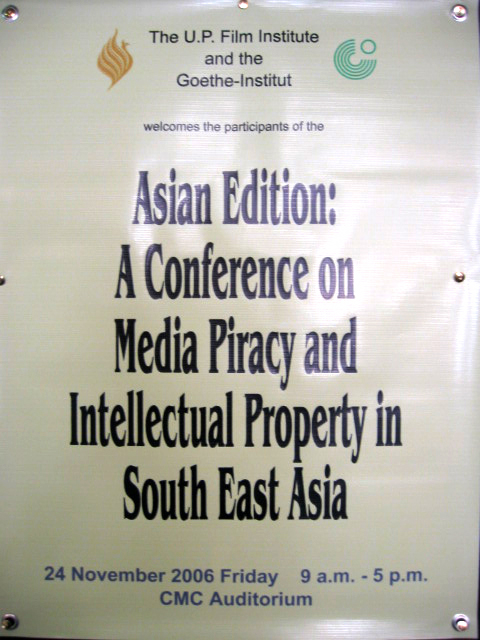
Asian Edition Conference
ASIAN EDITION
A Conference on Media Piracy and Intellectual Property in South East Asia
Sponsored by the Goethe Institute, Manila, and the UP Film Institute
Date: November 24, 2006, 9:00 am – 5:00 pm, UP Film Institute, University of the Philippines, Diliman, Metro Manila, CMC Auditorium
Many Filipinos still remember the "Asian Edition" - a scheme during the Marcos years, when American textbooks were reprinted locally and without paying royalties to the original publishers. Now, “Asian Edition” serves as title for a conference that will look at the phenomenon of media piracy in South East Asia today. Music, movie and software piracy is one of the most prominent media issues of the digital millennium. In the Philippines it has started a whole underground economy and currently seems to change the way movies and other media products are distributed and consumed products here and in other South East Asian countries.
The goal of the workshop is to contribute to an informed discussion of media piracy and issues of Intellectual Property in the age of digital reproduction. Instead of portraying piracy exclusively as a crime against artists and distributors, the proposed workshop will look at piracy as a social, cultural and economic phenomenon. And it will discuss new concepts of addressing ownership of Intellectual Property, such as Creative Commons and Open Source. Dr. Tilman Baumgärtel, Visiting Professor at the University of the Philippines, organizes the conference.
Conference INDEX
http://www.asian-edition.org/index.html
Conference PROCEEDINGS and ARTICLE LINKS
http://www.asian-edition.org/proceedings.html
http://www.asian-edition.org/links.html
Conference Programme and Participants
http://www.asian-edition.org/programm.html
http://www.asian-edition.org/participants.html

A Conference on Media Piracy and Intellectual Property in South East Asia
Sponsored by the Goethe Institute, Manila, and the UP Film Institute
Date: November 24, 2006, 9:00 am – 5:00 pm, UP Film Institute, University of the Philippines, Diliman, Metro Manila, CMC Auditorium
Many Filipinos still remember the "Asian Edition" - a scheme during the Marcos years, when American textbooks were reprinted locally and without paying royalties to the original publishers. Now, “Asian Edition” serves as title for a conference that will look at the phenomenon of media piracy in South East Asia today. Music, movie and software piracy is one of the most prominent media issues of the digital millennium. In the Philippines it has started a whole underground economy and currently seems to change the way movies and other media products are distributed and consumed products here and in other South East Asian countries.
The goal of the workshop is to contribute to an informed discussion of media piracy and issues of Intellectual Property in the age of digital reproduction. Instead of portraying piracy exclusively as a crime against artists and distributors, the proposed workshop will look at piracy as a social, cultural and economic phenomenon. And it will discuss new concepts of addressing ownership of Intellectual Property, such as Creative Commons and Open Source. Dr. Tilman Baumgärtel, Visiting Professor at the University of the Philippines, organizes the conference.
Conference INDEX
http://www.asian-edition.org/index.html
Conference PROCEEDINGS and ARTICLE LINKS
http://www.asian-edition.org/proceedings.html
http://www.asian-edition.org/links.html
Conference Programme and Participants
http://www.asian-edition.org/programm.html
http://www.asian-edition.org/participants.html
Subscribe to:
Posts (Atom)