Where Do CDs Go to Die?
EcoGeek Blog
Dear EcoGeek,
Is it possible to recycle old CD's or DVD's?
Thanks,
Rob
The perpetual scourge of EcoGeekiness is obsolescence. We pay good money for what we see as a good product, and then five years down the line we're surrounded by useless junk!
But I can't help but answer this seemingly straightforward question with several different answers.
First, I'll actually answer the question
Yes, you can, but it's not as simple as curbside pickup. CDs and DVDs do contain valuable materials (CDRs even sometimes contain gold) and there are techniques to harvest that material for reuse, but those same materials make them too complicated for regular recycling centers. Unfortunately, the materials aren't expensive enough that someone will pay for them. To recycle CDs you'll have to ship them to a special recycling center. Several are listed at the bottom of this post.
Second, Destroy the Data
Whenever you're trashing something that might contain personal data, always take the time to wipe it clean. For CDs, this can be accomplished with gloved hands, scissors, a hole puncher or, for a more entertaining (and dangerous) destruction, microwave on high for two seconds.
Third, Dubious Re-Use
The internet is littered with cheesy ways to reuse old CDs. Give people lemons and they'll make coasters, disco balls, clocks and maybe even miniature hover-craft. However, this isn't really helping anyone. At the very least, it's delaying the landfill for another few years. It's fun to play with trash, but this kind of re-use doesn't make much environmental sense.
Forth, Stop the Cycle
As with any article about obsolete materials, we'd be fools not to mention how evil forced obsolescence is. The good news is, nowadays we don't need to buy physical objects anymore. We can download pretty much everything we need straight to our hard drive, consume it, and throw it into the virtual trash can on our desktop. Whenever you can, go digital. But avoid the temptation to burn all your files to DVD. You'll just be staring at them in five years wondering what the heck you're going to do with all those coasters.
http://ecogeekblog.greenoptions.com/2007/06/28/ask-the-ecogeek-where-do-cds-go-to-die/
Thursday, June 28, 2007

Sunday, June 24, 2007
The Quiapo Cinematheque
The Quiapo Cinematheque
By Eric S. Caruncho
Inquirer
First Posted 09:15am (Mla time) 06/24/2007
MANILA, Philippines - Information wants to be free. Or at least, cheap. Nowhere is this dictum more apparent than in the bowels of Quiapo's Muslim district, now known to all and sundry as "Deeveedee."
When I first started frequenting the place five or so years ago, when pirated DVDs first came out, they cost P100 each. There was only a handful of ratty pirated DVD stalls huddled in a kind of talipapa along one block of Elizondo St. Out back was the porn section, a warren of dimly-lit cubicles with dirt floors, quite literally in the gutter, on which squatted the occasional naked urchin. It was a Dickensian experience, to say the least: Video Store of the Damned.
A few months later, the price had gone down to P80 per disc, and the stalls had multiplied exponentially, crossing Arlegui St. into the adjacent block.
In the ensuing months, the price went down further, to P60, and finally to P50 per disc. Two new building, with air-conditioning, had opened to serve the increasingly upmarket clientele for the bootleg discs. Then a couple more. And a few more.
Today, the "Deeveedee" district spans several blocks running southward from R. Hidalgo St. all the way to the Golden Mosque in Globo de Oro, with DVDs that go for as low as P40 per disc, three discs for a hundred.
When I first started frequenting the area, it was, quite frankly, a pestilential slum, reputed to be a refuge for pickpockets, holdup men and all manner of unsavory characters. For the slumming suburbanite, that was part of the thrill, actually, as was the excitement offered by the occasional raid by agents of the Videogram Regulatory Board.
Today, a mere five years of the bootleg trade have given the area what decades of development planning by the city government have not: a veneer of prosperity. The traders have graduated from scooters to AUVs, and a service industry of sorts has emerged to serve the resident population: convenience stores, halal restaurants, hotels. (I am just waiting for Starbucks and a foot spa to set up shop.)
I know, I know. Video piracy is killing the movie industry. But i's also sustaining a growing community of migrants who depend on the trade for their livelihood. One “expose” by a TV network even suggested that the pickpockets, holdup men and other unsavory characters mentioned earlier have shifted to selling DVDs which, I suppose, is a good thing, or at least the lesser of two evils.
A friend of mine, a noted film director who shall remain anonymous here for obvious reasons, calls the district the "Quiapo Cinematheque," presumably because whatever else it might be, Quiapo is a haven for the discerning cineaste.
The Cinematheque Francaise was where the directors of the French nouvelle vague, the likes of Truffaut, Godard and Rohmer, cut their teeth on Hollywood classics, world cinema and American B-movies alike. It is the Parthenon of film geekdom, celebrated in that scene from Bernardo Bertolucci's "The Dreamers" where the heroes watch a screening of Jean Luc Godard's "Band of Outsiders" at the Cinematheque and reenact a scene from the movie at the Louvre. (Incidentally, I have both films on DVD, bootlegs naturally).
"It's only an educated guess, but the next generation of Filipino filmmakers is, very likely, receiving the bulk of their education in cinema from bootleg DVDs, rather than from film school or Mowelfund or the occasional embassy screening as used to be the case. And just as Quentin Tarantino educated himself by working as a clerk at a video store and watching every piece-of-crap tape that looked interesting, these movie geeks could show us something tomorrow that we've never seen before.
One thing that anti-piracy advocates neglect to mention is the appalling lack of choice of titles in legit DVDs. Go to any legit video store and chances are, all you’ll get is mainstream Hollywood product.
Not so at the Quiapo Cinematheque.
The sheer diversity of bootleg product is staggering: there are stalls specializing in anime, film classics, concert videos and music films, telenovelas, and of course, porn. Cost aside, the strength of the Quiapo Cinematheque lies in its total promiscuity: slick Hollywood product, cheapo trash, undisputed classics of world cinema: it's all there, uncut. There's only your own inner censor to draw the line. In a couple of years of shopping in Quiapo, I've managed to make up for 20 years of being too lazy to go to those Alliance Francaise or Goethe Institut screenings. French new wave? Italian neo-realism? Film noir? Hong Kong action? '70s Japanese bondage films? Zombie cannibal splatterfests? Korean romcoms? Silent films? Got 'em.
The deeveedee district is also one of the few places in the city where the mainstream Christian populace can have a close encounter with their Muslim brethren, even if it's only their DVD "suki." In a society where Islam still represents the extreme of "otherness," such cross-cultural meetings are few and far between. Who knows what effect these small transactions might have on future relations between the faiths?
Of course, with the global media conglomerates pressuring the US government to crack down on Intellectual Property (IP) pirates worldwide, all this could vanish just as quickly as it came to be. As technology advances and broadband services improve and become more accessible, optical media might just become obsolete. Illegal downloads might overtake illegal discs as the IP police's chief headache.
Information, after all, wants to be free.
Or at least, cheap.
By Eric S. Caruncho
Inquirer
First Posted 09:15am (Mla time) 06/24/2007
MANILA, Philippines - Information wants to be free. Or at least, cheap. Nowhere is this dictum more apparent than in the bowels of Quiapo's Muslim district, now known to all and sundry as "Deeveedee."
When I first started frequenting the place five or so years ago, when pirated DVDs first came out, they cost P100 each. There was only a handful of ratty pirated DVD stalls huddled in a kind of talipapa along one block of Elizondo St. Out back was the porn section, a warren of dimly-lit cubicles with dirt floors, quite literally in the gutter, on which squatted the occasional naked urchin. It was a Dickensian experience, to say the least: Video Store of the Damned.
A few months later, the price had gone down to P80 per disc, and the stalls had multiplied exponentially, crossing Arlegui St. into the adjacent block.
In the ensuing months, the price went down further, to P60, and finally to P50 per disc. Two new building, with air-conditioning, had opened to serve the increasingly upmarket clientele for the bootleg discs. Then a couple more. And a few more.
Today, the "Deeveedee" district spans several blocks running southward from R. Hidalgo St. all the way to the Golden Mosque in Globo de Oro, with DVDs that go for as low as P40 per disc, three discs for a hundred.
When I first started frequenting the area, it was, quite frankly, a pestilential slum, reputed to be a refuge for pickpockets, holdup men and all manner of unsavory characters. For the slumming suburbanite, that was part of the thrill, actually, as was the excitement offered by the occasional raid by agents of the Videogram Regulatory Board.
Today, a mere five years of the bootleg trade have given the area what decades of development planning by the city government have not: a veneer of prosperity. The traders have graduated from scooters to AUVs, and a service industry of sorts has emerged to serve the resident population: convenience stores, halal restaurants, hotels. (I am just waiting for Starbucks and a foot spa to set up shop.)
I know, I know. Video piracy is killing the movie industry. But i's also sustaining a growing community of migrants who depend on the trade for their livelihood. One “expose” by a TV network even suggested that the pickpockets, holdup men and other unsavory characters mentioned earlier have shifted to selling DVDs which, I suppose, is a good thing, or at least the lesser of two evils.
A friend of mine, a noted film director who shall remain anonymous here for obvious reasons, calls the district the "Quiapo Cinematheque," presumably because whatever else it might be, Quiapo is a haven for the discerning cineaste.
The Cinematheque Francaise was where the directors of the French nouvelle vague, the likes of Truffaut, Godard and Rohmer, cut their teeth on Hollywood classics, world cinema and American B-movies alike. It is the Parthenon of film geekdom, celebrated in that scene from Bernardo Bertolucci's "The Dreamers" where the heroes watch a screening of Jean Luc Godard's "Band of Outsiders" at the Cinematheque and reenact a scene from the movie at the Louvre. (Incidentally, I have both films on DVD, bootlegs naturally).
"It's only an educated guess, but the next generation of Filipino filmmakers is, very likely, receiving the bulk of their education in cinema from bootleg DVDs, rather than from film school or Mowelfund or the occasional embassy screening as used to be the case. And just as Quentin Tarantino educated himself by working as a clerk at a video store and watching every piece-of-crap tape that looked interesting, these movie geeks could show us something tomorrow that we've never seen before.
One thing that anti-piracy advocates neglect to mention is the appalling lack of choice of titles in legit DVDs. Go to any legit video store and chances are, all you’ll get is mainstream Hollywood product.
Not so at the Quiapo Cinematheque.
The sheer diversity of bootleg product is staggering: there are stalls specializing in anime, film classics, concert videos and music films, telenovelas, and of course, porn. Cost aside, the strength of the Quiapo Cinematheque lies in its total promiscuity: slick Hollywood product, cheapo trash, undisputed classics of world cinema: it's all there, uncut. There's only your own inner censor to draw the line. In a couple of years of shopping in Quiapo, I've managed to make up for 20 years of being too lazy to go to those Alliance Francaise or Goethe Institut screenings. French new wave? Italian neo-realism? Film noir? Hong Kong action? '70s Japanese bondage films? Zombie cannibal splatterfests? Korean romcoms? Silent films? Got 'em.
The deeveedee district is also one of the few places in the city where the mainstream Christian populace can have a close encounter with their Muslim brethren, even if it's only their DVD "suki." In a society where Islam still represents the extreme of "otherness," such cross-cultural meetings are few and far between. Who knows what effect these small transactions might have on future relations between the faiths?
Of course, with the global media conglomerates pressuring the US government to crack down on Intellectual Property (IP) pirates worldwide, all this could vanish just as quickly as it came to be. As technology advances and broadband services improve and become more accessible, optical media might just become obsolete. Illegal downloads might overtake illegal discs as the IP police's chief headache.
Information, after all, wants to be free.
Or at least, cheap.
Friday, November 24, 2006
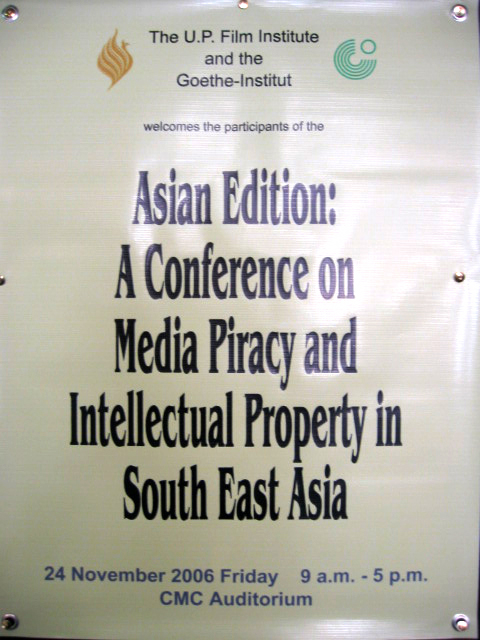
Asian Edition Conference
ASIAN EDITION
A Conference on Media Piracy and Intellectual Property in South East Asia
Sponsored by the Goethe Institute, Manila, and the UP Film Institute
Date: November 24, 2006, 9:00 am – 5:00 pm, UP Film Institute, University of the Philippines, Diliman, Metro Manila, CMC Auditorium
Many Filipinos still remember the "Asian Edition" - a scheme during the Marcos years, when American textbooks were reprinted locally and without paying royalties to the original publishers. Now, “Asian Edition” serves as title for a conference that will look at the phenomenon of media piracy in South East Asia today. Music, movie and software piracy is one of the most prominent media issues of the digital millennium. In the Philippines it has started a whole underground economy and currently seems to change the way movies and other media products are distributed and consumed products here and in other South East Asian countries.
The goal of the workshop is to contribute to an informed discussion of media piracy and issues of Intellectual Property in the age of digital reproduction. Instead of portraying piracy exclusively as a crime against artists and distributors, the proposed workshop will look at piracy as a social, cultural and economic phenomenon. And it will discuss new concepts of addressing ownership of Intellectual Property, such as Creative Commons and Open Source. Dr. Tilman Baumgärtel, Visiting Professor at the University of the Philippines, organizes the conference.
Conference INDEX
http://www.asian-edition.org/index.html
Conference PROCEEDINGS and ARTICLE LINKS
http://www.asian-edition.org/proceedings.html
http://www.asian-edition.org/links.html
Conference Programme and Participants
http://www.asian-edition.org/programm.html
http://www.asian-edition.org/participants.html

A Conference on Media Piracy and Intellectual Property in South East Asia
Sponsored by the Goethe Institute, Manila, and the UP Film Institute
Date: November 24, 2006, 9:00 am – 5:00 pm, UP Film Institute, University of the Philippines, Diliman, Metro Manila, CMC Auditorium
Many Filipinos still remember the "Asian Edition" - a scheme during the Marcos years, when American textbooks were reprinted locally and without paying royalties to the original publishers. Now, “Asian Edition” serves as title for a conference that will look at the phenomenon of media piracy in South East Asia today. Music, movie and software piracy is one of the most prominent media issues of the digital millennium. In the Philippines it has started a whole underground economy and currently seems to change the way movies and other media products are distributed and consumed products here and in other South East Asian countries.
The goal of the workshop is to contribute to an informed discussion of media piracy and issues of Intellectual Property in the age of digital reproduction. Instead of portraying piracy exclusively as a crime against artists and distributors, the proposed workshop will look at piracy as a social, cultural and economic phenomenon. And it will discuss new concepts of addressing ownership of Intellectual Property, such as Creative Commons and Open Source. Dr. Tilman Baumgärtel, Visiting Professor at the University of the Philippines, organizes the conference.
Conference INDEX
http://www.asian-edition.org/index.html
Conference PROCEEDINGS and ARTICLE LINKS
http://www.asian-edition.org/proceedings.html
http://www.asian-edition.org/links.html
Conference Programme and Participants
http://www.asian-edition.org/programm.html
http://www.asian-edition.org/participants.html
Sunday, October 29, 2006
The DVD Rewinder

Too many DVDs, and CDs and not enough time to rewind? Are your DVDs running a bit too slow? The DVD rewinder is the perfect solution! This novelty rewinder comes with the exclusive Centriptal Velocity Spindle providing the world's fastest DVD rewind!
The DVD Rewinder is a great gift for the technical savvy, the couch potato, teens with too much time on their hands, and the gadget buff! Novelty for you or gag gift for a friend.
The DVD Rewinder has a great black and fluorescent green color scheme with high tech styling! The DVD Rewinder will spin discs backwards and plays a rewind sound. You can also record your own rewind sound which provides unending possibilities. For the tech hip, the DVD Rewinder also has an additional MP3 port and plays a separate rewind sound. Rewind all types of disc media DVDs, CDs, and Console Games. But not just novelty, the DVD Rewinder has utility. It has a built in compartment that holds a disc cleaner. This compartment can be used to hold the cleaner, loose couch change, tooth picks, keys or other small items. A truly unique product with a truly unique design!
An actual product for sale, for the bargain-basement price of $16.49. Requires one nine volt battery.
The DVD Rewinder requires (1) 9V battery.
I know someone who could really use this as a gift!You can spend your hard-earned dollars to purchase it here
Tuesday, April 18, 2006
Copyleft: The Freedom to Copy and Share the Work With Others
 Copyleft is a play on the word copyright and describes the practice of using copyright law to remove restrictions on distributing copies and modified versions of a work for others and requiring that the same freedoms be preserved in modified versions.
Copyleft is a form of licensing and may be used to modify copyrights for works such as computer software, documents, music, and art. In general, copyright law allows an author to prohibit others from reproducing, adapting, or distributing copies of the author's work. In contrast, an author may, through a copyleft licensing scheme, give every person who receives a copy of a work permission to reproduce, adapt or distribute the work as long as any resulting copies or adaptations are also bound by the same copyleft licensing scheme. A widely used and originating copyleft license is the GNU General Public License. Similar licenses are available through Creative Commons — called Share-alike.
Copyleft may also be characterized as a copyright licensing scheme in which an author surrenders some but not all rights under copyright law. Instead of allowing a work to fall completely into the public domain (where no copyright restrictions are imposed), copyleft allows an author to impose some but not all copyright restrictions on those who want to engage in activities that would otherwise be considered copyright infringement. Under copyleft, copyright infringement may be avoided if the would-be infringer perpetuates the same copyleft scheme. For this reason copyleft licenses are also known as viral or reciprocal licenses.
More on COPYLEFT: http://en.wikipedia.org/wiki/Copyleft
There's The Rub / 10 things to love about being in the Philippines
There's The Rub
10 things to love about being in the Philippines
By Conrado de Quiros
Inquirer
First posted 00:30am (Mla time) April 18, 2006
THE IDEA for this column cropped up in my head late last week. I had pretty much forgotten how great Metro Manila felt without the crush of cars and jeepneys, beggars and businessmen, saints and sinners spilling out into its streets every day, until I drove around last Holy Thursday and Good Friday. Most Metro Manilans had left for their hometowns, if not for Boracay and Baguio City, and the taste of Metro Manila, near-emptied of its mechanical and human contents, was not unlike wine. Driving through deserted roads gave me a glimpse into how an Arab must feel driving through desert roads. It brought back memories of the time when I used to ride the JD and DM buses from Katipunan Road in Quezon City to Quiapo in Manila (that took only 15 minutes), which now seems like ancient history even to me.
The air was redolent as much of summer ease as of Lenten penitence, which made me think of some of the things to love about living in this country. My list breezed past 10, but columns are not hospitable to more than 10 of the things to love about being in the Philippines -- which does not include writing columns. So 10 it is:
One, Baguio and Boracay. Baguio is the old summer capital, Boracay the new one. Mountain or sea, take your pick. Though Baguio has been greatly ravaged by modernity -- enough to make you sing (appropriately, Baguio being home to “folk” music) Joni Mitchell’s line, “They paved paradise to put up a parking lot” -- it still retains its charm, at least for me, aided in no small way by a rush of memories. I haven’t been there in some time and find myself now and then longing for it.
Boracay, well, it makes a good claim to being the next best thing to paradise on Earth, though some beaches in Bohol province, notably on Panglao Island, can give it a run for its money. Personally, I find the addition of nightlife a boon and not a bane: I’m not one of those who like to rough it up in the company only of the moon and stars. Beer and good company help to make the sand sparkle in the night. In any case, I don’t much like dipping into the water, I just like walking on beaches. But that’s another story.
If you like the beach, you’ll probably like the people who inhabit it, too, especially the ones in Boracay. But I’ll stop there lest I get into trouble.
Two, fruits. My all-time favorite is mangoes, which have no peer in the world. Of course, you’ll find people from other Asian and Latin American countries boasting about their own mangoes, but I’ve tasted a variety of mangoes from all over the world, and I can say with reasonable certainty that none of them compares to ours. Our mangoes are the absolute best.
As well indeed as many of our other fruits, which teem all over the place at this time of year. I’ve always associated summer with fruits, the trees, which grew in abundance where I lived when I was a kid -- and this was supposed to be a city! -- groaning with the weight of them. The idea of buying fruits was inconceivable then. Fruits were not something you bought, they were something you picked. But that, too, now seems like ancient history.
Three, hometowns. The desolation of Metro Manila during Holy Week drove home the point that most residents of Metro Manila come from somewhere else in the country. “Taga saan ka?” [Where are you from?] is a normal question you ask of a Metro Manilan, which suggests that those whose antecedents for several generations date back to any part of the metropolis are the minority, probably a small minority. My own hometown is Naga City, though I was born in Manila. It is where I spent my boyhood and adolescence and learned my first language, which is Bicol. It is where I go to charge my psychic batteries. I barely know anybody there anymore from childhood, but the place itself holds a raging volcano of memories for me, which sends electrical surges through my soul. Hometowns give you a sense of bearing in a world -- especially so this country -- seemingly drifting in space, bound for nowhere.
Four, the sun. That, of course, is also something to hate about living in this country when the heat becomes especially ferocious at this time of year. But you live in a cold place, and truly you’ll learn to love the sun. I’ve been in Europe in the bitter cold a couple of times and was instantly cured of Christmas-y notions of winter wonderlands. Once when sunlight seeped through the gray skies in the Oxford area where I was visiting some years ago, I swear I thought I would see the natives fall on their knees and pray. The exultation was universal, the sighs of gratefulness spontaneous and audible.
I don’t hate it that we only have two seasons in this country, the rainy and the dry, which in these days of El Niño and La Niña weather disruptions are not so easy to demarcate anymore. I like it that we do, if only because of the teeming street children Metro Manila in particular is home to. Can you imagine them lying in the pavement in the bitter cold? I have these images of Russians being picked up in the morning like litter after freezing to death from lying in the snow roaring drunk. Of course, the fact that we do have children sleeping on the pavement while Mike Arroyo barely inhabits princely suites in Las Vegas to watch boxing champion Manny Paquiao fight is something to hate about living in this country. But I leave that for the nonce.
Five, summer. It revives memories of Connie Francis belting out “V-a-c-a-t-i-o-n!” The kids are home from school, though “home,” for those who have teenage sons in particular, is hugely debatable. Over the last several weeks, I’ve barely seen the shadow of my 17-year-old son. Well, I guess let them be. It’s the time of their life, the best years of their life, the happiest years of their life. It won’t come again.
SIX, DVD and software. It used to be you went to the United States to buy DVDs, software and books. Well, today you still go to the United States (and elsewhere) to buy books. I still remember the row upon row of bargain books in The Strand in New York, a cavernous bookshop where you need a ladder to get to the tomes on the top shelves. Many of them were still new and hardbound. The DVDs, well, the last time I got them in the United States was in 2001, shortly before 9/11, and I counted myself lucky to have bought them on sale.
Today, you do not go to the United States to buy DVDs; your folks in the United States come here to buy DVDs. Or importune you to send them some, such as your messenger is intrepid enough to risk problems at Immigration. Indeed, today your problem is not how to lay your hands on DVDs, or on good titles, your problem is how to organize the tons of them, including absolute classics, that are piling up in your not very big house. I have solved that problem by buying them without the case and storing them in canisters. I still have to solve the problem of how to find the time to watch them.
Those who feel like berating me for listing the DVDs from the Quiapo district in Manila among the things that make this country livable might first wish to examine whether the Windows they're using to boot their PCs and the software they're using to write their furious letters with are original or licensed.
Seven, Quiapo. Before my mother suffered a stroke some years ago, which much debilitated her mind if not her body, she used to go to Quiapo to do her marketing. She was born and raised in Manila. The fact that many markets, wet or super, were near did little to dissuade her from making the long trip by jeepney. She was already past her 80s then, but she was strong and strong-willed. Nothing beats Quiapo for the real deal, she said.
She was right. It was so then, it is so now. It's the one place where you get the best bang for the buck, in more ways than one.
It's a place, too, where you find tolerance amid difference, pattern amid incongruity, order amid chaos. It's the place where the Quiapo church stands just across the street from the mosque. It's the place where the sounds of prayer mingle with the cries of barkers, where bankers thrive with sellers of snake oil, where the benefits promised by public officials vie with the efficacious results promised by the peddlers of "pampalaglag" [abortifacients]. It's grimy, noisy and pushy. It's honest, colorful and sublime.
Eight, the countryside. That is to say, any place outside Metro Manila, not necessarily your hometown. The food is cheaper and the smiles are broader. In past years, I used to travel a lot across the country to talk in graduations and forums but I have kept to Manila of late because of pressing concerns. I like visiting the Visayas for many reasons, not the least of which is that it is accessible by air and sea. But more than that, the Spaniards were right: It's the land of the "pintados" [tattooed people], of a people given to wine and song. I won't mention what goes along with wine and song lest I get into trouble as well.
Of course, it's not always easy to keep an Amorsolo image of the countryside amid the want and strife to be found there. But you'd be a fool to imagine that's all you'll find in the countryside. Especially in summer, when the sun dangles from a cloudless sky and shimmers across undulating field and heaving sea. It's always a little brighter in the countryside in summer, which pulls you to it like, well, an Amorsolo painting.
Nine, "kakanin," "halo-halo. When I was a kid, you found the "kakanin" (pudding, rice cakes, etc.) plentifully in the market. But if you were too lazy to take the short walk there, there were the itinerant vendors who hawked the stuff in the streets. I recall that at one point one of our teachers in high school, an American Jesuit, who had been insisting that we speak slowly, audibly and clearly in class, pointed triumphantly to one of those itinerant vendors and cried, "That is how you should recite!" You could hear the voice of the kid from a distance shouting "Baduya" (banana drenched in batter) in the tones of an angel. Kakanin's gain, amateur hour's loss.
Two things I've always associated with summer: "tuli" [circumcision] and "halo-halo" [iced mix of fruits and other ingredients]. The first came from announcements in newspapers and signs in streets that said almost cryptically, "Summertime: Tuli!" To this day, I find myself saying that phrase every time Gershwin's famous ode to summertime is sung. The second is halo-halo, a concoction that makes you see and feel the haze of summer. Not least because it truly makes you full and sleepy. I know most of the ingredients there -- beans of all shapes and sizes -- are gout-inducing, but I figure that these days in particular there are more things to give you pain in this country than gout.
Ten, the people. I still recall something a friend of mine, an American banker, told me before he left for another post. He had pretty much gone around the world, he said, but he found few people as genuinely warm and solicitous as Filipinos. Of course, in excessive form, he said, Filipinos also tended to be familiar and intrusive, as when new acquaintances went on to pry into his personal life. But even that he found to be largely harmless, if not well-meaning. In the United States, he said, waiters and sales clerks greeted you, "Have a good day," but there was little joy or conviction in their eyes. Here, people said "Ingat" ["Take care"], and meant it.
I did think of writing as well "10 things to hate about being in the Philippines." But either that goes well past 10 or it can be reduced to just one, take your pick.
But that's quite another story. It's Easter, I'll leave the tragedies for tomorrow.
Editor's Note: Published on page A12 of the April 18, 2006 issue of the Philippine Daily Inquirer
10 things to love about being in the Philippines
By Conrado de Quiros
Inquirer
First posted 00:30am (Mla time) April 18, 2006
THE IDEA for this column cropped up in my head late last week. I had pretty much forgotten how great Metro Manila felt without the crush of cars and jeepneys, beggars and businessmen, saints and sinners spilling out into its streets every day, until I drove around last Holy Thursday and Good Friday. Most Metro Manilans had left for their hometowns, if not for Boracay and Baguio City, and the taste of Metro Manila, near-emptied of its mechanical and human contents, was not unlike wine. Driving through deserted roads gave me a glimpse into how an Arab must feel driving through desert roads. It brought back memories of the time when I used to ride the JD and DM buses from Katipunan Road in Quezon City to Quiapo in Manila (that took only 15 minutes), which now seems like ancient history even to me.
The air was redolent as much of summer ease as of Lenten penitence, which made me think of some of the things to love about living in this country. My list breezed past 10, but columns are not hospitable to more than 10 of the things to love about being in the Philippines -- which does not include writing columns. So 10 it is:
One, Baguio and Boracay. Baguio is the old summer capital, Boracay the new one. Mountain or sea, take your pick. Though Baguio has been greatly ravaged by modernity -- enough to make you sing (appropriately, Baguio being home to “folk” music) Joni Mitchell’s line, “They paved paradise to put up a parking lot” -- it still retains its charm, at least for me, aided in no small way by a rush of memories. I haven’t been there in some time and find myself now and then longing for it.
Boracay, well, it makes a good claim to being the next best thing to paradise on Earth, though some beaches in Bohol province, notably on Panglao Island, can give it a run for its money. Personally, I find the addition of nightlife a boon and not a bane: I’m not one of those who like to rough it up in the company only of the moon and stars. Beer and good company help to make the sand sparkle in the night. In any case, I don’t much like dipping into the water, I just like walking on beaches. But that’s another story.
If you like the beach, you’ll probably like the people who inhabit it, too, especially the ones in Boracay. But I’ll stop there lest I get into trouble.
Two, fruits. My all-time favorite is mangoes, which have no peer in the world. Of course, you’ll find people from other Asian and Latin American countries boasting about their own mangoes, but I’ve tasted a variety of mangoes from all over the world, and I can say with reasonable certainty that none of them compares to ours. Our mangoes are the absolute best.
As well indeed as many of our other fruits, which teem all over the place at this time of year. I’ve always associated summer with fruits, the trees, which grew in abundance where I lived when I was a kid -- and this was supposed to be a city! -- groaning with the weight of them. The idea of buying fruits was inconceivable then. Fruits were not something you bought, they were something you picked. But that, too, now seems like ancient history.
Three, hometowns. The desolation of Metro Manila during Holy Week drove home the point that most residents of Metro Manila come from somewhere else in the country. “Taga saan ka?” [Where are you from?] is a normal question you ask of a Metro Manilan, which suggests that those whose antecedents for several generations date back to any part of the metropolis are the minority, probably a small minority. My own hometown is Naga City, though I was born in Manila. It is where I spent my boyhood and adolescence and learned my first language, which is Bicol. It is where I go to charge my psychic batteries. I barely know anybody there anymore from childhood, but the place itself holds a raging volcano of memories for me, which sends electrical surges through my soul. Hometowns give you a sense of bearing in a world -- especially so this country -- seemingly drifting in space, bound for nowhere.
Four, the sun. That, of course, is also something to hate about living in this country when the heat becomes especially ferocious at this time of year. But you live in a cold place, and truly you’ll learn to love the sun. I’ve been in Europe in the bitter cold a couple of times and was instantly cured of Christmas-y notions of winter wonderlands. Once when sunlight seeped through the gray skies in the Oxford area where I was visiting some years ago, I swear I thought I would see the natives fall on their knees and pray. The exultation was universal, the sighs of gratefulness spontaneous and audible.
I don’t hate it that we only have two seasons in this country, the rainy and the dry, which in these days of El Niño and La Niña weather disruptions are not so easy to demarcate anymore. I like it that we do, if only because of the teeming street children Metro Manila in particular is home to. Can you imagine them lying in the pavement in the bitter cold? I have these images of Russians being picked up in the morning like litter after freezing to death from lying in the snow roaring drunk. Of course, the fact that we do have children sleeping on the pavement while Mike Arroyo barely inhabits princely suites in Las Vegas to watch boxing champion Manny Paquiao fight is something to hate about living in this country. But I leave that for the nonce.
Five, summer. It revives memories of Connie Francis belting out “V-a-c-a-t-i-o-n!” The kids are home from school, though “home,” for those who have teenage sons in particular, is hugely debatable. Over the last several weeks, I’ve barely seen the shadow of my 17-year-old son. Well, I guess let them be. It’s the time of their life, the best years of their life, the happiest years of their life. It won’t come again.
SIX, DVD and software. It used to be you went to the United States to buy DVDs, software and books. Well, today you still go to the United States (and elsewhere) to buy books. I still remember the row upon row of bargain books in The Strand in New York, a cavernous bookshop where you need a ladder to get to the tomes on the top shelves. Many of them were still new and hardbound. The DVDs, well, the last time I got them in the United States was in 2001, shortly before 9/11, and I counted myself lucky to have bought them on sale.
Today, you do not go to the United States to buy DVDs; your folks in the United States come here to buy DVDs. Or importune you to send them some, such as your messenger is intrepid enough to risk problems at Immigration. Indeed, today your problem is not how to lay your hands on DVDs, or on good titles, your problem is how to organize the tons of them, including absolute classics, that are piling up in your not very big house. I have solved that problem by buying them without the case and storing them in canisters. I still have to solve the problem of how to find the time to watch them.
Those who feel like berating me for listing the DVDs from the Quiapo district in Manila among the things that make this country livable might first wish to examine whether the Windows they're using to boot their PCs and the software they're using to write their furious letters with are original or licensed.
Seven, Quiapo. Before my mother suffered a stroke some years ago, which much debilitated her mind if not her body, she used to go to Quiapo to do her marketing. She was born and raised in Manila. The fact that many markets, wet or super, were near did little to dissuade her from making the long trip by jeepney. She was already past her 80s then, but she was strong and strong-willed. Nothing beats Quiapo for the real deal, she said.
She was right. It was so then, it is so now. It's the one place where you get the best bang for the buck, in more ways than one.
It's a place, too, where you find tolerance amid difference, pattern amid incongruity, order amid chaos. It's the place where the Quiapo church stands just across the street from the mosque. It's the place where the sounds of prayer mingle with the cries of barkers, where bankers thrive with sellers of snake oil, where the benefits promised by public officials vie with the efficacious results promised by the peddlers of "pampalaglag" [abortifacients]. It's grimy, noisy and pushy. It's honest, colorful and sublime.
Eight, the countryside. That is to say, any place outside Metro Manila, not necessarily your hometown. The food is cheaper and the smiles are broader. In past years, I used to travel a lot across the country to talk in graduations and forums but I have kept to Manila of late because of pressing concerns. I like visiting the Visayas for many reasons, not the least of which is that it is accessible by air and sea. But more than that, the Spaniards were right: It's the land of the "pintados" [tattooed people], of a people given to wine and song. I won't mention what goes along with wine and song lest I get into trouble as well.
Of course, it's not always easy to keep an Amorsolo image of the countryside amid the want and strife to be found there. But you'd be a fool to imagine that's all you'll find in the countryside. Especially in summer, when the sun dangles from a cloudless sky and shimmers across undulating field and heaving sea. It's always a little brighter in the countryside in summer, which pulls you to it like, well, an Amorsolo painting.
Nine, "kakanin," "halo-halo. When I was a kid, you found the "kakanin" (pudding, rice cakes, etc.) plentifully in the market. But if you were too lazy to take the short walk there, there were the itinerant vendors who hawked the stuff in the streets. I recall that at one point one of our teachers in high school, an American Jesuit, who had been insisting that we speak slowly, audibly and clearly in class, pointed triumphantly to one of those itinerant vendors and cried, "That is how you should recite!" You could hear the voice of the kid from a distance shouting "Baduya" (banana drenched in batter) in the tones of an angel. Kakanin's gain, amateur hour's loss.
Two things I've always associated with summer: "tuli" [circumcision] and "halo-halo" [iced mix of fruits and other ingredients]. The first came from announcements in newspapers and signs in streets that said almost cryptically, "Summertime: Tuli!" To this day, I find myself saying that phrase every time Gershwin's famous ode to summertime is sung. The second is halo-halo, a concoction that makes you see and feel the haze of summer. Not least because it truly makes you full and sleepy. I know most of the ingredients there -- beans of all shapes and sizes -- are gout-inducing, but I figure that these days in particular there are more things to give you pain in this country than gout.
Ten, the people. I still recall something a friend of mine, an American banker, told me before he left for another post. He had pretty much gone around the world, he said, but he found few people as genuinely warm and solicitous as Filipinos. Of course, in excessive form, he said, Filipinos also tended to be familiar and intrusive, as when new acquaintances went on to pry into his personal life. But even that he found to be largely harmless, if not well-meaning. In the United States, he said, waiters and sales clerks greeted you, "Have a good day," but there was little joy or conviction in their eyes. Here, people said "Ingat" ["Take care"], and meant it.
I did think of writing as well "10 things to hate about being in the Philippines." But either that goes well past 10 or it can be reduced to just one, take your pick.
But that's quite another story. It's Easter, I'll leave the tragedies for tomorrow.
Editor's Note: Published on page A12 of the April 18, 2006 issue of the Philippine Daily Inquirer
Wednesday, January 11, 2006
There's The Rub / Encounters
There's The Rub
Encounters
By Conrado de Quiros
Inquirer
First posted 11:32pm (Mla time) Jan 10, 2006
A FRIEND of mine asked me if I had any thoughts about initiatives that could help bridge the divide between Muslims and Christians in this country. He and some colleagues were looking for instances of dialogue, or cultural encounters, that promoted peace, or curbed hostilities, between those warring factions.
I said half in jest that my friend would do better looking for those instances not in the south but right here in the city. As far as I knew, I said, the perfect model for Christian-Muslim harmony was to be found in Quiapo. Nothing spoke of the heights of mutual tolerance than the Quiapo Church, bastion of Catholicism, on one side of the street coexisting with the Muslim mosque, citadel of Islam, on the other side of it.
Thinking about it later, however, I realized it wasn't a joke at all. A perfectly serious case could be made for it. The "taming of the Moro [native Muslim] quarter" in Quiapo should make for an interesting study, academic or otherwise, offering as it does a wealth of insights into how to turn swords into plowshares.
Not too long ago, the place was a virtual no-man's land. During Alfredo Lim's time as mayor of Manila, in particular, the "Muslim center," as it was often referred to, which is that side of Quiapo opposite the Quiapo Church, past the underpass, all the way to Arlegui, Globo de Oro, and the other small clogged streets that run through there like the arteries of someone badly needing a heart bypass, was whispered with the same awe and dread as "Tondo" in the 1960s. It was not uncommon to find "salvage" victims there. Nor was it uncommon to find close encounters of the bloody kind between cops and robbers there, the robbers disappearing into the folds of the place as into a foggy redoubt and the cops refusing to follow. Many a cop that did so failed to come out alive.
That at least was the image that gripped the public mind, aided in no small way by the tabloids that screamed the mayhem in bold headlines. Until a few years ago, vestiges of that unsavory reputation still clung to that place. When I told people that the cheapest place to buy DVDs was in Quiapo, specifically the Muslim area, some of them were aghast and marveled at my intrepidness in venturing that far afield. I assured them there was nothing fearful about the place, it was nowhere near the wild frontier they supposed it to be. The wariness has disappeared almost completely today. The place is still a sprawl, dirty and grimy, and muddy on rainy days, but it is also home particularly on weekends to Mitsubishi Pajero and Honda CRV sports utility vehicles, parked on its periphery, in the area under the Quiapo Bridge. Or what used to be called "Isle de Tulle," the Frenchified "ilalim ng tulay," or under the bridge.
What had wrought this amazing transformation? The DVDs, of course.
Or more accurately the "pirated DVDs," which can be bought for a song in those parts, or however P50 counts these days. The periodic raids of Edu Manzano's henchmen notwithstanding, which look more and more like an elaborate ritual taken for PR purposes, the DVD market grows by leaps and bounds. The fringes are caught up in it too and keep expanding. The downside I leave the believers in intellectual property rights to argue. The upside is that you find no quarrels between the inebriated crowd that heaves the Black Nazarene through the streets on its feast day shouting pious litanies and the sober one loudly chanting praises to Allah particularly during the lean and hungry days of Ramadan. If that isn't tolerance, I don't know what is.
Two things I gather from this, which could have some bearing on the work of peace advocates. One is that the presumed animosity between Christians and Muslims in this country is more imagined than real. I don't know how it is in Muslim Mindanao, I suspect it is just as exaggerated. The animosity hasn't seeped into the level of the man in the street. I do know that in the Visayas, there are still numerous reminders of the Moro piratical raids. Tagbilaran, the capital of Bohol, as I learned some years ago, means "tago B'laan," or to hide from the pirates. I do know that the Feast of the Cross in some parts of Leyte is related to the many miracles the Cross of Christ apparently worked to protect Visayan communities from the Moro pirates in Spanish times.
But I don't know that the animosity is active today among ordinary folk. The distrust seems to have less to do with the idea of a Moro stabbing you in the back than with him stabbing you in the pocket. Courtesy of all those jokes about the Moro trader, but which are no more and no less than the jokes about the sly Chinese and shrewd Bombay.
The second and more important thing you can glean from the experience is that you turn people into stakeholders, or give them a stake in peace, you get peace. People who have a source of livelihood will not imperil their source of livelihood. Today, the "barangay" [neighborhood district] council in the Muslim quarter zealously keeps the peace there, fearful that any mugging or bloodletting could ward off the droves of visitors that regularly descend on it. Of course some people will argue that pirated DVDs, which for reasons I have yet to fathom have become a Moro franchise-they're the ones selling the thing even in Baguio City, or so someone tells me-are not unlike Colombian cocaine. And some will say the pirated DVDs suggest that Moros have not gotten over their time-honored skullduggery. I disagree completely, though I'll leave my arguments there for another day. Suffice it for me to say that the only thing that suggests skull and crossbones from where I stand are the periodical raids of Edu's men which take on the aspect of Francis Drake's one-eyed and toothless men looting the loot-laden Spanish galleons.
By the way, have you seen the early works of Ingmar Bergman...?
Editor's Note: Published on Page A12 of the January 11, 2006 issue of the Philippine Daily Inquirer
Encounters
By Conrado de Quiros
Inquirer
First posted 11:32pm (Mla time) Jan 10, 2006
A FRIEND of mine asked me if I had any thoughts about initiatives that could help bridge the divide between Muslims and Christians in this country. He and some colleagues were looking for instances of dialogue, or cultural encounters, that promoted peace, or curbed hostilities, between those warring factions.
I said half in jest that my friend would do better looking for those instances not in the south but right here in the city. As far as I knew, I said, the perfect model for Christian-Muslim harmony was to be found in Quiapo. Nothing spoke of the heights of mutual tolerance than the Quiapo Church, bastion of Catholicism, on one side of the street coexisting with the Muslim mosque, citadel of Islam, on the other side of it.
Thinking about it later, however, I realized it wasn't a joke at all. A perfectly serious case could be made for it. The "taming of the Moro [native Muslim] quarter" in Quiapo should make for an interesting study, academic or otherwise, offering as it does a wealth of insights into how to turn swords into plowshares.
Not too long ago, the place was a virtual no-man's land. During Alfredo Lim's time as mayor of Manila, in particular, the "Muslim center," as it was often referred to, which is that side of Quiapo opposite the Quiapo Church, past the underpass, all the way to Arlegui, Globo de Oro, and the other small clogged streets that run through there like the arteries of someone badly needing a heart bypass, was whispered with the same awe and dread as "Tondo" in the 1960s. It was not uncommon to find "salvage" victims there. Nor was it uncommon to find close encounters of the bloody kind between cops and robbers there, the robbers disappearing into the folds of the place as into a foggy redoubt and the cops refusing to follow. Many a cop that did so failed to come out alive.
That at least was the image that gripped the public mind, aided in no small way by the tabloids that screamed the mayhem in bold headlines. Until a few years ago, vestiges of that unsavory reputation still clung to that place. When I told people that the cheapest place to buy DVDs was in Quiapo, specifically the Muslim area, some of them were aghast and marveled at my intrepidness in venturing that far afield. I assured them there was nothing fearful about the place, it was nowhere near the wild frontier they supposed it to be. The wariness has disappeared almost completely today. The place is still a sprawl, dirty and grimy, and muddy on rainy days, but it is also home particularly on weekends to Mitsubishi Pajero and Honda CRV sports utility vehicles, parked on its periphery, in the area under the Quiapo Bridge. Or what used to be called "Isle de Tulle," the Frenchified "ilalim ng tulay," or under the bridge.
What had wrought this amazing transformation? The DVDs, of course.
Or more accurately the "pirated DVDs," which can be bought for a song in those parts, or however P50 counts these days. The periodic raids of Edu Manzano's henchmen notwithstanding, which look more and more like an elaborate ritual taken for PR purposes, the DVD market grows by leaps and bounds. The fringes are caught up in it too and keep expanding. The downside I leave the believers in intellectual property rights to argue. The upside is that you find no quarrels between the inebriated crowd that heaves the Black Nazarene through the streets on its feast day shouting pious litanies and the sober one loudly chanting praises to Allah particularly during the lean and hungry days of Ramadan. If that isn't tolerance, I don't know what is.
Two things I gather from this, which could have some bearing on the work of peace advocates. One is that the presumed animosity between Christians and Muslims in this country is more imagined than real. I don't know how it is in Muslim Mindanao, I suspect it is just as exaggerated. The animosity hasn't seeped into the level of the man in the street. I do know that in the Visayas, there are still numerous reminders of the Moro piratical raids. Tagbilaran, the capital of Bohol, as I learned some years ago, means "tago B'laan," or to hide from the pirates. I do know that the Feast of the Cross in some parts of Leyte is related to the many miracles the Cross of Christ apparently worked to protect Visayan communities from the Moro pirates in Spanish times.
But I don't know that the animosity is active today among ordinary folk. The distrust seems to have less to do with the idea of a Moro stabbing you in the back than with him stabbing you in the pocket. Courtesy of all those jokes about the Moro trader, but which are no more and no less than the jokes about the sly Chinese and shrewd Bombay.
The second and more important thing you can glean from the experience is that you turn people into stakeholders, or give them a stake in peace, you get peace. People who have a source of livelihood will not imperil their source of livelihood. Today, the "barangay" [neighborhood district] council in the Muslim quarter zealously keeps the peace there, fearful that any mugging or bloodletting could ward off the droves of visitors that regularly descend on it. Of course some people will argue that pirated DVDs, which for reasons I have yet to fathom have become a Moro franchise-they're the ones selling the thing even in Baguio City, or so someone tells me-are not unlike Colombian cocaine. And some will say the pirated DVDs suggest that Moros have not gotten over their time-honored skullduggery. I disagree completely, though I'll leave my arguments there for another day. Suffice it for me to say that the only thing that suggests skull and crossbones from where I stand are the periodical raids of Edu's men which take on the aspect of Francis Drake's one-eyed and toothless men looting the loot-laden Spanish galleons.
By the way, have you seen the early works of Ingmar Bergman...?
Editor's Note: Published on Page A12 of the January 11, 2006 issue of the Philippine Daily Inquirer
Subscribe to:
Posts (Atom)